Miserable and Spending
Watch what they do, not what they say.
American consumers have never felt worse about the economy. They have also never spent more. Both things are true at the same time, and only one of them matters for earnings.
What they say
The Conference Board’s consumer confidence index fell to 81.9 in September, the lowest reading since 2014, and a huge miss against expectations of 89.2. The University of Michigan’s sentiment gauge sits near historic lows. Ask people about the economy and you hear the same three things: prices are too high, gas costs too much, jobs feel shaky.
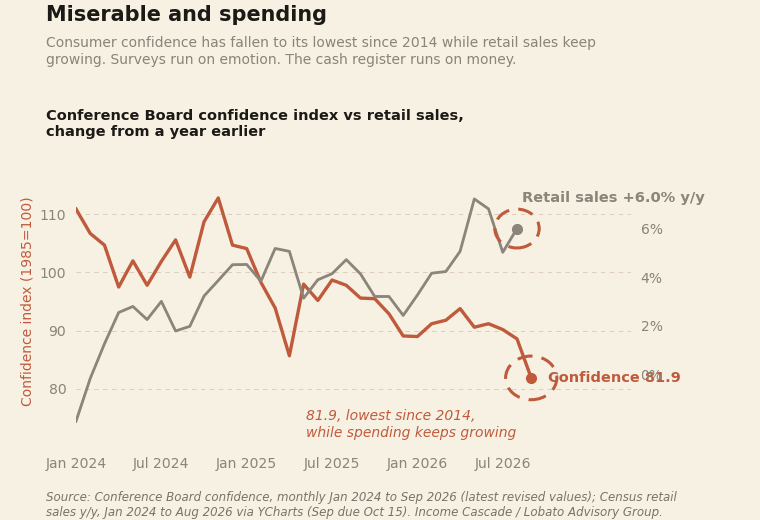
None of this is new. Sentiment surveys have been weak for years while the hard data stayed solid. Surveys run on emotion. They overshoot in both directions.
What they do
Retail sales are up 5.4% from a year ago. Adjusted for inflation, consumer spending is up about 2.6%. August spending jumped 0.9% in a single month, the biggest monthly gain of 2026. Small business sales rose 2.2% year over year in September, the strongest gain since June, on back-to-school demand.
They are not spending blindly. They are spending deliberately. Foot traffic has fallen for eleven straight months. Average tickets are up 4.2%. Translation: fewer trips, bigger baskets, higher prices doing the heavy lifting. Money moved toward retail and groceries and away from restaurants. Consumers are shifting dollars between categories, pulling back where they can, paying where they must.
That is resilience, but it is tired resilience.
Why the gap matters
Soft data versus hard data is the oldest trick in economic analysis. Sentiment is a survey of feelings. Spending is a record of actions. Feelings swing harder and faster than wallets, which is why sentiment has called for recessions that never arrived.
But sentiment is not useless. History says changes in how people feel show up in spending about a year later. So these numbers do not impact earnings now. They impact earnings in 2027, if the slump holds. That is the one to keep a close eye on: sentiment is the early warning, spending is the confirmation. The signal is not “consumers are fine.” The signal is “consumers are still spending, for now, and straining underneath.”
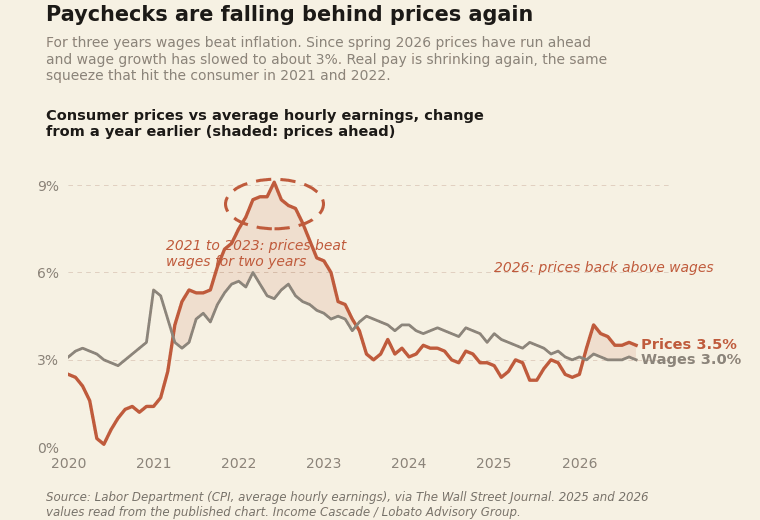
The strain is visible in the details. Eleven months of falling foot traffic means people are consolidating trips to save gas money. Restaurant visits are declining while grocery spending rebounds: cooking at home instead of eating out. Clothing foot traffic rose while average tickets fell: buying, but buying cheaper. This is a consumer managing decline in real purchasing power, not one living large.
The wealth effect
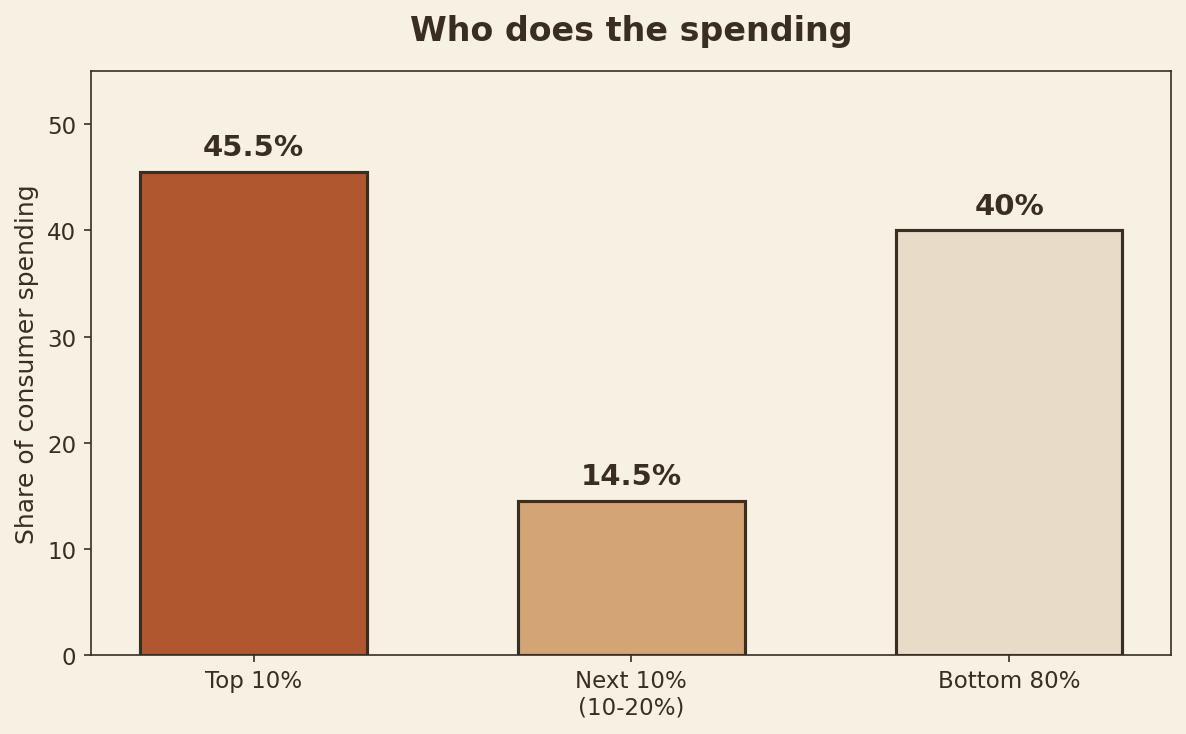
There is a simpler explanation for the gap, and it sits at the top of the income ladder. The top 20% of households now drive about 60% of all consumer spending, according to Moody's Analytics. The top 10% alone account for 45.5%. Those households are not spending from paychecks. They are spending from portfolios.
Household net worth hit a record $196 trillion in the second quarter of 2026, up $13 trillion on a $10.7 trillion jump in equity holdings. The S&P 500 has more than tripled since its 2020 low. The top 10% control 69% of the wealth and own 87% of all stocks. When the market rises, they feel richer and they spend. That is the wealth effect, and it is concentrated exactly where the spending is.
The AI boom is the engine. The same megacap tech names driving the market are the ones in those portfolios. Rising equity values fund the spending that keeps the aggregate numbers healthy, even as sentiment surveys scream. The consumer is not one person. It is two economies: the top 20% spending from wealth, everyone else spending from wages that are barely keeping up.
What the banks see
The banks see every swipe. Bank of America’s 70 million customers put more than $400 billion a month through its cards, and CEO Brian Moynihan says they spent 5 to 6% more this June than last. “Affordability is a real issue,” he admits. “What people are doing is still spending money, and that’s good for the U.S. economy in the broadest context.”
JPMorgan’s Jamie Dimon is blunter about the cycle: “It’s getting close to as good as it gets. We just don’t know how long it’s going to last.” His bank just cut its 2026 card loss outlook to 3.2% from 3.4%, because losses are running better than expected. Citi’s Jane Fraser says “little of the data I see tells me the US is on the cusp of a recession,” pointing to household savings as “a cushion for future stress.”
The New York Fed’s data backs them up, with a catch. Card balances hit $1.263 trillion in the second quarter, and about 7% of balances slipped into serious delinquency, roughly flat from a year ago. Auto loan delinquencies sit near a 23-year high. Subprime auto just posted its worst delinquency rate in 32 years, and repossessions in 2025 were the highest since 2009.
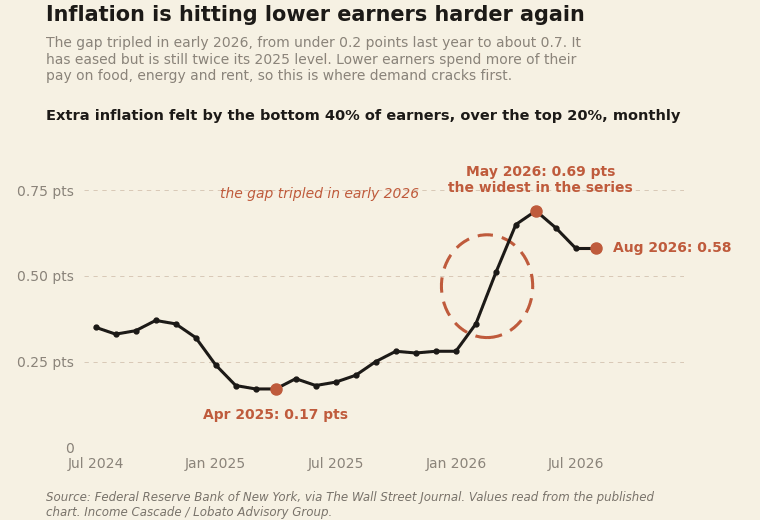
So the stress is real but concentrated: lower earners, subprime borrowers, buy-now-pay-later users putting groceries on installment plans. The prime borrower, the one the big banks mostly serve, is fine. That is exactly the split this whole piece is about. The aggregate numbers look healthy because the top two-thirds of households are carrying them.
The takeaway
In the short term, what matters for markets is the cash register, not the survey. Earnings come from spending, and spending is still growing. That is the second pillar holding this economy up, next to the AI capex boom: businesses keep investing, consumers keep buying, and the sentiment surveys keep screaming into the void. But keep a close eye on the stress underneath. If it starts to turn the spending tide, that is when it hits earnings.
Watch the hard data for the turn. When foot traffic stabilizes, the consumer is healing. When tickets stop growing faster than traffic, inflation is actually easing. And when spending itself rolls over, believe it, because by then the surveys will have been right for a year and no one will be listening.
Sources: Conference Board Consumer Confidence, September 2026; University of Michigan Surveys of Consumers; Fiserv Small Business Index, September 2026; U.S. Census Bureau retail sales; New York Fed Household Debt and Credit Report, Q2 2026; JPMorgan, Bank of America and Citigroup Q2 2026 earnings.