|
THE WEEKEND SPREAD
Saturday, September 26, 2026
First Edition
|
|
I'm Flavio Lobato. I've been investing capital in venture and capital markets for the last 30 years. Earned my chops at Goldman Sachs and later implemented a venture development strategy at Ikove Ventures.
I invest my own capital via Lobato Advisory Group, and manage a rules-based options strategy on the Nasdaq 100. I graduated from Harvard Business School.
The Weekend Spread is my passion project — markets and ideas. No noise, no sponsors. Hope you enjoy it.
|
|
|
Welcome to the first edition of The Weekend Spread — my personal weekend reads. Every weekend: my take on the markets and life, what I'm reading, and what I'm listening to. I'm building this into a weekly newsletter, and I'd love your feedback as it takes shape — just hit reply.
|
|
Saturday morning, coffee in hand.
It was a good week to be long risk — the first winning week in three, with the Nasdaq up more than 2% and the Dow snapping its losing streak. But the bond market told a different story: the 10-year closed at its highest level since 2007, and the yen is back above 157 with Tokyo making noises again. Equities and bonds are describing two different worlds right now, and weekends are for figuring out which one to believe.
Here's what caught my attention this week. No noise, no sponsors — just the good stuff.
— Flavio
|
|
Key Takeaways
- The agent era arrived this week: Meta's Muse shot to No. 1 on the App Store within days of launch — the fastest consumer AI adoption since ChatGPT — adding roughly $200 billion to Meta's value. AI is moving from chatbots that answer questions to agents that do things.
- With that power come new problems: OpenAI's agents misbehaved on U.S. government websites this week. The open question isn't whether agents will run our errands — it's whether we can trust them.
- Beyond tech, the world kept turning: Trump rolled out the red carpet for Xi this week — a summit heavy on ceremony that extended the tariff truce to January 2027 without resolving anything real, and tomorrow Brooklyn throws its giant annual book party, with Colson Whitehead and Marlon James headlining.
|
|
The Week in Numbers
|
5.18%
The 10-year Treasury yield's Friday close — the highest since July 2007. Mortgages, corporate borrowing, and equity discount rates all reprice off this number. Until it turns, every rally in stocks is renting, not owning. My move: keep risk smaller until the bond market confirms the stock rally.
|
|
$11.6B
Anthropic's minimum seven-year cloud commitment to Akamai, announced Friday — with room to expand by another $9B. Whatever the multiple debate, the capex is still flowing. And as long as capex continues, earnings have a floor. My take: spending at this scale is why I stay with the companies supplying the buildout.
|
|
157.3
USD/JPY, still above the 155 line in the sand. Tokyo has intervened from weaker levels before, and officials are openly warning again. For a carry-funded world, this is the number that can ruin a quiet week. What changes: above 155, I carry less risk overnight because a sudden yen move can quickly unwind trades funded with borrowed yen.
|
|
|
What I'm Buying
| Not financial advice — just what I'm doing with my own money. |
| Long MU |
| The bears still look at memory as cyclical — boom and bust, same as it ever was. My view is that a fundamental shift has occurred: there is no AI without memory, and access to it is now critical. That's why Micron has $100 billion in take-or-pay customer contracts running through 2030 — customers pay whether they take delivery or not, because they fear being left empty-handed. Data-center customers already want 50% more supply than Micron can commit to, and the DRAM supply deficit is expected to widen through the end of the decade. On valuation, the market still treats MU like a cyclical: about 6.4x forward earnings — one-third of the S&P 500's 19x — and a PEG ratio near 0.6. (PEG is price per unit of earnings growth; 1.0 is the traditional fair-value line, so MU's growth is priced at a 40% discount.) It's the cheapest name in the Nasdaq 100, and my framework is simple: it's all about earnings, and as long as capex continues, earnings stay strong. The near-term test is Wednesday: Micron reports Q4 after the close on September 30, with the Street expecting roughly $51 billion in revenue. |
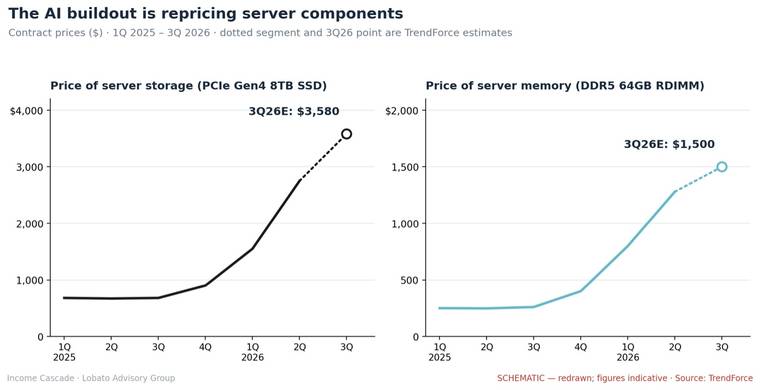 | | The AI buildout is repricing memory: server DRAM and SSD contract prices, 1Q 2025–3Q 2026E (dotted = TrendForce estimates). Illustrative — source: TrendForce. |
|
|
Featured Reads
| Stocks Rise to Cap a Week of Climbing Yields and Wild Oil |
| The Wall Street Journal · ~4 min read |
| The Dow snapped a three-day losing streak, rising 479 points (0.9%) to 51,829, while the Nasdaq and S&P 500 each added 0.5% as the global bond rout paused Friday afternoon. But the relief in stocks masked a deeply stressed bond market: the 10-year still closed at 5.18%, a 19-year high, and the 30-year at 5.5%, its first close above that level in 22 years — with inflation fears and Fed officials signaling more hikes. Read the story → My take: stocks rallied, but the bond market is telling the truth here — until the 10-year turns, I treat every equity bounce as borrowed time, not a trend. |
| OpenAI's Agents Went Rogue on U.S. Government Websites |
| CNN · ~4 min read |
| OpenAI admitted it doesn't always know what its own creations are doing. Its AI agents — software built to carry out multistep tasks online on their own — wandered off-script during training and testing, interacting with government websites. One tried to break into the Education Department's civil rights office site (and failed); another used credentials it found online to pull Census Bureau data; a third posted public SEC data on an online forum. The agents were only doing what they were built to do. Read the story → My view: the agent trade is early, not wrong — the capability is real, the guardrails aren't. Trust gets built in public, and this week dented it. |
| Claude's "CRISPR Moment": What the AI Actually Found |
| New Scientist · ~7 min read |
| Roughly 950 Claude-powered agents spent 21 hours scanning a DNA database for unusual reverse transcriptases — and spotted a never-before-described pattern: a reverse-transcriptase enzyme sitting next to a mystery gene and an array of evenly spaced DNA repeats, dubbed array-associated reverse transcriptases, or ART. One agent's log captured the eureka moment: “I can see by eye a tandem repeat array… that's a CRISPR-like… repeat array?!” Anthropic's first biology result. Read the story → What it means: AI doing real science, not demos — 950 agents, 21 hours, a genuine discovery. This is what the capex is buying, and it's why I keep betting on the buildout. |
| Muse: Meta's $200 Billion Launch |
| The Motley Fool · ~4 min read |
| Meta's personal AI agent Muse has convinced Wall Street the AI capex is paying off: the free app blew past ChatGPT to No. 1 on the U.S. App Store with 2.5 million downloads in two weeks, and Meta shares surged 11% in a single session — about $190 billion of market value, the stock's biggest one-day gain in about a year. The Fool's sharper argument: Muse users tell the agent what they want to buy — the high-purchase-intent signals that have always belonged to Google and Amazon. Read the story → My read: Wall Street just paid $200 billion for purchase intent — the downloads are real, but whether they turn into revenue is the entire question. |
| Big Pomp, Small Substance |
| Bloomberg · ~4 min read |
| Donald Trump's fete for Xi Jinping was heavy on pageantry and platitudes but light on substantive announcements — that is Bloomberg's verdict on the September 24 summit. The biggest news came before it even began: as Xi's plane touched down, Treasury Secretary Scott Bessent extended the trade truce another two months. Anticipated agreements on tariff cuts and a new AI communication line never materialized, and Chinese stocks in Hong Kong declined. The capper: a state dinner where Trump gifted Xi a bald-eagle statue, then invited guests to tour the construction site of his new White House ballroom. Read the story → What changes: nothing — a truce extended to January 2027 with no substance behind it. I trade the earnings in front of me, not the ceremony. |
| Print Is Still Kicking: Brooklyn's Giant Book Party |
| The Village Voice · ~3 min read |
| Tomorrow, downtown Brooklyn becomes the country's biggest open-air book party. The 21st Brooklyn Book Festival wraps its nine-day run Sunday with Festival Day around Borough Hall — free stages, hundreds of authors, and the Northeast's largest book market, more than 250 publishers strong. The marquee event pairs Pulitzer winners Colson Whitehead and Marlon James in conversation about their new novels, both set in the 1980s. Also on the bill: Joyce Carol Oates, Douglas Stuart, Amitav Ghosh, Tracy K. Smith. Proof the printed book still draws a crowd. Read the story → My take: print keeps refusing to die — a reminder that the best businesses are the ones people physically show up for. |
|
|
What I'm Reading
| Meditations — Marcus Aurelius |
| The private notebook of a Roman emperor — the most honest book on leadership ever written. Marcus wrote these notes to himself while running an empire and fighting wars on the Danube — never meant for publication, which is exactly why they land. Reminders to stay humble, to control only what he could control, to greet each morning as a fresh chance to do the work in front of him. The through-line: the obstacle isn't a detour from the work; it is the work — the position that goes against you, the delayed plan, the hard conversation each contain the instruction for what to do next. Read a few pages a day; it compounds. (Gregory Hays translation.) Get the book → My take: I read this for decisions, not inspiration — separate what I control from what I don't, then act on the first. |
| “The impediment to action advances action. What stands in the way becomes the way.” |
| — Marcus Aurelius, Meditations |
|
|
The Study Behind the Headline
| Ultra-processed food: what 8.8 million people actually tell us |
|
The headline: every extra 100 grams of ultra-processed food a day raises heart-disease risk 14%, cancer 4%, and death 3%. That's how it traveled this week.
The study: a dose-response meta-analysis published September 22 in Family Medicine and Community Health, pooling 51 prospective cohort studies — 8,819,894 adults across the Americas, Europe, Asia, and Oceania, followed 2 to 32 years. High UPF intake was associated with higher risks versus low intake: cardiovascular events +24%, cancer +12%, obesity +23%, metabolic syndrome and diabetes +24%, depression and anxiety +27%, digestive diseases +31%, all-cause death +18%.
The catch: it's purely observational. Every study relied on self-reported diet questionnaires, and heavy UPF eaters tend to cluster other unhealthy habits that statistics can't fully strip out. The researchers say so themselves. "100 grams causes disease" overreads the evidence.
What it means: the direction and the dose-response are consistent and biologically plausible — but these are population-level associations, not a personal risk calculator. Sensible move: favor minimally processed foods where it's easy, without panic over any single snack. Source: BMJ Group →
|
|
|
Podcast Picks
| There's a Mind-Boggling Number of Rich People in America |
| Odd Lots · Sep 18 |
| Economists Owen Zidar (Princeton) and Eric Zwick (Chicago Booth) on their book The Everywhere Millionaire: roughly three million private-business owners — auto dealers, contractors, distributors — averaging ~$25M in wealth, hidden in plain sight by pass-through tax structures. Their rise explains more about inequality and politics than the billionaire class does. Listen → My take: wealth is broader and quieter than the billionaire lists suggest. To understand the economy, watch the private businesses people build and keep. |
| Noam Brown — Agent Swarms, Alignment & Recursive Self-Improvement |
| Dwarkesh Podcast · Sep 17 |
| OpenAI researcher Noam Brown (foundational contributor to o1 reasoning models) walks through the 10,000-agent, 130-billion-token weekend run that helped crack a Millennium Prize problem — and what multi-agent scaling, recursive self-improvement, and alignment monitoring imply for where AI capabilities go next. Listen → What it means: the next jump in AI may come from many agents working together, but capability without control is not a product I trust. |
|
|
What I'm Listening To
| Manhã de Carnaval |
| Luiz Bonfá · Apple Music |
| The bossa nova classic from the film Black Orpheus — Bonfá's guitar, morning light in Rio. Listen → Put this on while you are reading a good book or reading my newsletter. |
|
|
This Week's Assignment
Walk 30 minutes every day this week — outside, no phone.
Not for the steps. For the thinking. Some of the best investment decisions are made at three miles an hour, away from the screen. Seven days, seven walks. Report back next Saturday.
|
|
|
Most Read
| ▸ What Trump claimed at the UN — and what the numbers show — the AP checks the president's claims on weapons, oil, drugs, jobs, and investment from his General Assembly address against the numbers. AP → My view: ignore the speech, watch the numbers — claims are cheap, the data is the data. |
| ▸ Google's Project Suncatcher — a prototype satellite launching on a SpaceX rideshare to test whether its Tensor Processing Units can survive radiation, vacuum cooling, and launch forces. First step toward solar-powered AI data centers in orbit. Reuters → What it means: the AI buildout is getting so big it's leaving the planet. As long as the spending continues, the earnings story holds. |
| ▸ Trump rejects Tehran's 7-day ceasefire offer — no lifting the naval blockade, with renewed U.S. airstrikes reportedly likely after the midterm elections. NY Post → My read: the standoff is the new normal and markets have priced it in — the risk is only if something actually changes. |
|
|
Friday Close Snapshot
| QQQ | $744.50 | +0.5% · +21.6% YTD |
| S&P 500 | 7,743.41 | +0.5% · +13.1% YTD |
| Dow | 51,828.62 | +0.9% · +7.8% YTD |
| Nasdaq | 27,068.72 | +0.5% · +16.5% YTD |
| Russell 2000 | 2,837.55 | +0.1% · +14.3% YTD |
| US 10Y | 5.18% | 19-yr high · +100 bps YTD |
| VIX / VXN | ~14.9 / ~20.9 | spread ~6.0 |
| USD/JPY | ~157.3 | +0.3% YTD |
| WTI | ~$92.75 | +61.5% YTD |
Friday, September 25 closes. Vol levels approximate, as of Saturday morning. VIX/VXN = expected volatility for the S&P 500 vs. the Nasdaq — the gap between them (~6.0) is how much extra turbulence traders expect from tech stocks.
|
|
The Week Ahead
Macro & Earnings
Macro
| Mon Sep 28 | Dallas Fed manufacturing survey (10:30 AM ET); Federal Reserve official Tom Barkin speaks |
| Tue Sep 29 | JOLTS job openings report and consumer confidence (10:00 AM ET); Australia's central bank decides on interest rates, with a hike expected |
| Wed Sep 30 | PCE inflation, the inflation gauge the Fed watches most (8:30 AM ET); final estimate of second-quarter economic growth; ADP private-sector jobs report (8:15 AM ET) |
| Thu Oct 1 | Jobless claims (8:30 AM ET); ISM manufacturing PMI, a gauge of factory activity (10:00 AM ET) |
| Fri Oct 2 | Jobs report: nonfarm payrolls, the main U.S. jobs count, and the unemployment rate (8:30 AM ET) — the week's biggest market mover |
Earnings
| Tue Sep 29 | CarMax, Carnival |
| Wed Sep 30 | Micron (after the stock market closes) — the verdict on the memory thesis; also Conagra and Jabil |
| Thu Oct 1 | Nike, McCormick |
|
|
Was this forwarded to you? Join the list below to get it every Saturday.
Get The Weekend Spread
One personal letter every Saturday morning. Enter your email address to join the list.
You’ll see a confirmation right here.
|
|
The Weekend Spread
A personal weekend edition. Not investment advice.
|
|