
The Weekend Spread
Saturday, October 17, 2026 · Edition #4
|
|
A NOTE TO START
Hi, I am Flavio Lobato. The Weekend Spread is my passion project. My personal take on markets, business, and ideas. No noise, no sponsors.
This week, a rounding error erased two trillion dollars. Anthropic reported some of the best growth numbers I have ever seen, and some are still criticizing it as a slowdown. In Washington, science grants keep sliding, with fiscal 2026 clocking in at half the long-run number. This issue also launches Startup Corner, opening with AssetWatch. And in Travel, my wife Sachenka and I share our love for Portugal. Hope you enjoy this issue.
|
KEY TAKEAWAYS
- Inflation came in one notch hot, and the market's whole week turned on it. By Friday's close the chip stocks had given back about two trillion dollars. And the selling did not stop at the weaker names, with CoreWeave, the poster child of the leveraged nature of the AI buildout, down about 12% on Friday alone and its bonds now yielding over 15%.
- China's model makers and chip firms are closing the gap, and Anthropic's revenue more than tripled in two quarters. Follow the earnings, not the noise.
- Washington is pulling back from basic science. New NSF grants have fallen by roughly half, and the research that becomes companies in five years starts there. A slow problem, and a real one.
THIS WEEK'S HIGHLIGHT
One Tenth of One Percent
Watch the two-minute video on The Tape →
One number, a tenth of a percent, decided the week. September inflation printed hotter than expected, and by Friday's close the chip stocks had given back about two trillion dollars.
Read it on The Tape: theweekendspread.com/tape/one-tenth-of-one-percent/ (the two-minute video is at the top of the page)
FEATURED READS
|
★ THE ELECTION READ
The Map in Six States
Silver Bulletin, updated Oct 13 · Reading time: about 6 min
Numbers only. Silver Bulletin updated its forecast on Oct 13 and shows Democrats as strong favorites to retake the House. The Senate turns on six tipping point states, Maine, Texas, Ohio, Iowa, Michigan, and Alaska, where Democratic candidates lead by between 1.5 and 3.7 points in the polling averages. Even Kansas shows a narrow Democratic lead of 1.2 points. The page pairs state maps with a generic ballot dashboard, updated daily.
Read the article →
My take: I read the map, not the commentary. Six states decide the Senate, and they are close enough that turnout settles it, not persuasion.
|
Did the Numbers Ruin the Game?
Harvard Gazette · Reading time: about 5 min
Moneyball is old news. Every team now employs an army of analysts, and Charles Barkley says the result "sucks": endless three-pointers in the NBA, home run or strikeout in baseball. Harvard's take is more balanced. Analytics also brought more scoring, a faster pace, and bolder fourth-down calls. The real problem is imitation. When one team finds an edge, all 30 copy it, and the games start to look the same. The fix, per one Harvard statistician: once everyone plays the same way, the edge is in doing the opposite.
Read the article →
My take: every edge dies the same way, once everyone copies it. Sports just got there first. Markets work exactly the same.
China's Chip Sector Is Moving Faster Than Expected
Goldman Sachs Insights · Reading time: about 4 min
Goldman Sachs brought 400 companies and more than 1,400 investors together in Hong Kong and came back with two messages. China's semiconductor industry, from chip design to foundries to the equipment that makes the chips, is advancing faster than the market expected. Local equipment makers are guiding to 40% annual revenue growth. Its AI models are closing the performance gap too, especially in coding, so the competition is shifting to cost and price per unit of performance. The bottleneck has not moved: GPUs. Everything still runs on computing power China cannot yet produce at scale.
Read the article →
My take: the gap is closing on everything except the one thing that matters, computing power at scale. Watch that, not the model headlines.
The Trafficker Who Furnished the Museums of LA
Hyperallergic, Oct 12 · Reading time: about 8 min
A new Getty book, built from the newly opened archive of Los Angeles gallerist Earl Stendahl, traces how looted and smuggled ancient Mesoamerican objects, some altered and some outright fabricated, found their way into LA museums and Hollywood collections. The centerpiece story: Minneapolis paid $10,000 in 1947 for a stone figure billed as a King Chak Mool, toured it through Europe as a cornerstone of the collection, and learned a decade later that it was a forgery. A history of how the art world looked the other way.
Read the article →
My take: the museums bought the story because they wanted the objects. Provenance was somebody else's problem, until it was not.
France's Borrowing Costs Are at a 20-Year High
TechTimes, Oct 5 · Reading time: about 4 min
France now pays more to borrow for ten years than Italy or Greece, and its gap over Germany, whose bonds are called Bunds, reached about 1.5 percentage points this month, the widest in more than 20 years. The European Central Bank has a crisis tool for exactly this, but its rules block using it for a country that has not met the fiscal conditions, and France's deficit is running at 5.4% of GDP. It is the fiscal dominance story from this week's Lab piece, happening live.
Read the article →
My take: this is fiscal dominance in real time. When the central bank cannot rescue you because you broke the rules, the bond market writes the budget.
THE WEEK IN NUMBERS
- 0.1: the percentage points by which September inflation beat expectations.
- $2 trillion: roughly what the big chip stocks gave back across the selloff.
- -7.6%: South Korea's Kospi on Thursday, its worst day of the week in Asia, with Samsung down 9.5%.
- 6,200: new NSF grants awarded in fiscal 2026, roughly half a normal year, down from 11,600 in fiscal 2021. See the Chart of the Week.
THE STUDY BEHIND THE HEADLINE
The Galaxies That Should Not Exist
Quanta Magazine, Oct 14 · Reading time: about 8 min
The headline version of how the universe works: every galaxy is held together by dark matter, the invisible material that outweighs ordinary matter five to one. The study: astronomers found a trio of faint galaxies that appear to have almost none. They think a past collision stripped the dark matter away while leaving the stars behind. That is awkward for rival theories of gravity, which predict dark matter effects should always show up in galaxies like these. The find gives scientists a rare clean test of what dark matter is, and what it is not.
Read the article →
My take: three faint galaxies just gave scientists the cleanest test of dark matter in years.
CHART OF THE WEEK
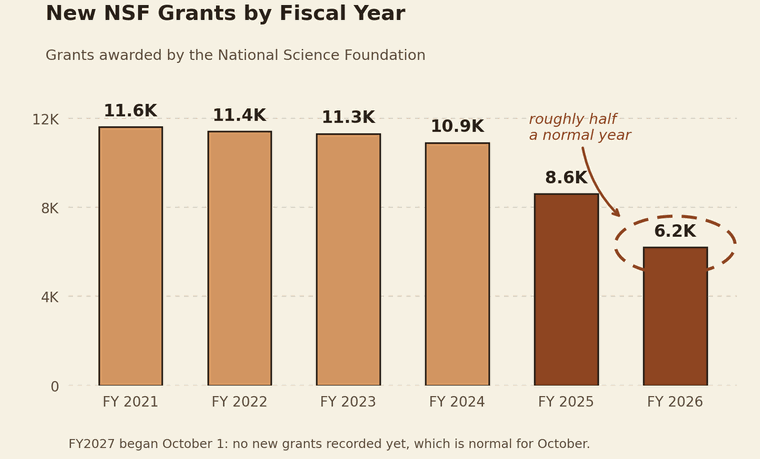
Chart: Prof G Media. Source: Grant Witness.
New grants from the National Science Foundation by fiscal year: about 11,000 a year was normal. Fiscal 2025 fell to 8,600, and fiscal 2026 to 6,200, roughly half a normal year. Note: fiscal 2027 began on October 1, and no new grants have been recorded yet. That is normal for October; in every year on this chart the line stays at zero until December.
My take: I have been working on technology commercialization for almost 15 years. Federal grants are a lifeblood for basic research at universities; without them, amazing discoveries never get out of the lab. The company featured in this issue's Startup Corner, AssetWatch, is a case study in how federally funded basic research, joined by private capital and entrepreneurial grit, created one of the fastest growing companies in America.
QUOTE OF THE WEEK
"In the short run, the market is a voting machine, but in the long run, it is a weighing machine."
Benjamin Graham, The Intelligent Investor
This week the market was dominated by the short term view of the voting machine, but what really measures value is the undeniable weight of earnings growth.
PODCAST PICKS
Paul McCartney on Good Hang with Amy Poehler
Good Hang with Amy Poehler · Listening time: about 60 min
Amy Poehler gets a relaxed, funny hour with Paul McCartney, with his daughter Stella joining. He talks about his first job winding coils in a Liverpool factory for a weekly pay packet he almost chose over a Cavern gig with John Lennon and George Harrison, and why he still calls himself a playaholic rather than a workaholic. He also admits the one collaborator he is still too nervous to call is Bob Dylan. Warm, loose, and full of small stories you have not heard told this way.
Listen →
My take: the easiest hour of the week. He has told these stories for sixty years and still makes them sound new, and the playaholic line explains all of it.
Anthropic's Quest to Give A.I. Morals, Hard Fork
Hard Fork · Listening time: about 44 min
Anthropic has been holding private meetings with religious scholars about AI consciousness and how to make Claude "good." Times reporters Elizabeth Dias, Erin Griffith, and David Wallace-Wells unpack the new belief systems forming in Silicon Valley, and where Anthropic parts ways with the Vatican.
Listen →
My take: the paradox is the story. A company growing faster than any in history, sitting with theologians to ask whether its machines have souls and what doing good means. Growth versus goodness, in the same room.
Further reading: "Religious Scholars Met With Anthropic. What They Heard Stunned Them." Elizabeth Dias, The New York Times, Sep 29.
STARTUP CORNER
AssetWatch and the $1.4 Trillion Problem
Unplanned downtime costs the world's largest manufacturers $1.4 trillion a year (Siemens Senseye, "The True Cost of Downtime," 2024). Most machine failures do not happen without warning: they signal trouble days or weeks ahead, in vibration, heat and wear. AssetWatch hears those signals in time to schedule the repair instead of suffering the stoppage.
This week it widened its ears, adding electrical monitoring to the platform, catching the faults vibration sensors miss.
Disclosure: I co-founded AssetWatch (originally Nikola Labs) and served as its Chairman for its first five years. I remain an investor.
Read the announcement →
Source: AssetWatch press release, Oct 13, 2026.
FROM THE SITE THIS WEEK
The Lab: "Inflation, Explained," what it is, where it comes from, and why a dollar from 1913 buys what about 3 cents buys today.
Watch the video in The Lab →
The Tape: "Nobody's Getting Fired. Nobody's Getting Hired." a labor market frozen solid, layoffs near 50-year lows, hiring stalled, and nobody quitting, and why the freeze matters.
Watch the video on The Tape →
CULTURE
This week in Culture: a trip, a song, a show, and a book. What I'm traveling to, listening to, watching, and reading in print. See it all on the site →
 Travel: Two Weeks in Portugal. Sunset at Quinta da Comporta. My wife Sachenka and I travel to Portugal quite often, and for this feature we curated a special trip: our favorite itinerary. Lisbon was home base, with day trips to Sintra and Fatima, then the drive south: the beach villages of Comporta, the cliffs of Carvoeiro in the Algarve, and Evora in the Alentejo wine country. See the full trip → |  Music: "Autumn in New York," Chet Baker (1956). Seven minutes of trumpet, unhurried and a little wistful. It sounds like the city in October. Listen → |  Video: The Diplomat (Netflix). Keri Russell as Kate Wyler, a career diplomat posted to London in the middle of an international crisis. Smart, fast, and funny in the right places. Our video pick this week. Watch: Netflix | 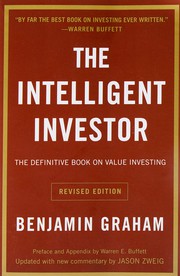 Bookshelf: The Intelligent Investor, Benjamin Graham. The source of this week's quote: Graham's 1949 classic on value investing, the book that taught Warren Buffett. Visit → |
Flavio's take: culture is the part of the portfolio that provides the highest return.
THE WEEK AHEAD
A quieter week on the data, with earnings doing the talking.
- The Fed goes silent. Officials stop speaking ahead of the October 27-28 meeting, where the next rate decision lands on October 28.
- Housing gets the early week: homebuilder sentiment Monday, housing starts and permits Tuesday.
- Thursday brings the weekly jobless claims. Friday brings the first look at October business activity surveys and the final read on consumer sentiment.
- Earnings: Netflix and General Motors on Tuesday. Tesla, IBM, and Lam Research on Wednesday. Procter & Gamble and Blackstone on Thursday. American Express on Friday.
- The week after is the big one: the Fed decides on Wednesday, October 28, and Meta, Microsoft, and Alphabet all report that same evening. Amazon follows on Thursday. Apple lands the Monday after, November 2.
THE WEEK IN THE MARKETS
Friday, October 16 close.
| | Close | Day |
| S&P 500 | 7,659.44 | -1.09% |
| Nasdaq Composite | 26,140.03 | -2.15% |
| Dow Jones | 52,002.41 | -0.34% |
| Nasdaq 100 (QQQ) | $709.80 | -2.50% |
| Gold | $4,188.60 | +0.44% |
| Oil (WTI) | $98.91 | +0.96% |
| Bitcoin | $81,540 | -0.73% |
| 10-year Treasury | 5.10% | |
Thank You for Reading my newsletter.
I'm Flavio Lobato. I've been investing capital in venture and capital markets for the last 30 years. Earned my chops at Goldman Sachs and later implemented a venture development strategy at Ikove Ventures.
I invest my own capital via Lobato Advisory Group, and manage a rules-based options strategy on the Nasdaq 100. I graduated from Harvard Business School.
The Weekend Spread is my passion project, markets and ideas. No noise, no sponsors. Hope you enjoy it.
|
Know someone who'd enjoy this? Forward it to a friend.
Subscribe: weekendspreadnewsletter@gmail.com · Unsubscribe
© 2026 Lobato Advisory Group LLC. All rights reserved.
|
|
|
|
|
|