
The Weekend Spread
Saturday, October 3, 2026 · Edition #2
SUBSCRIBE
One email, every Saturday morning. No noise.
A NOTE TO STARTTwo things stayed with me this week. First, MU reported a monster quarter: $54 billion in revenue and capex going up, the one number my whole thesis hinged on. Second, researchers at my alma mater found that U.S. senators vote the way their desk neighbors vote, which explains more about Washington than most campaign memoirs. And the project I'm proudest of this month: Money and Investing 101 is live: a twelve-month program teaching what school never taught me (I graduated in Finance and never learned the basics: not how to balance a checkbook, not the danger of credit card debt). Month 1, "Pay Yourself First," is out now: invest 10% of your net income, minimum, starting today. And because life isn't all markets: I'm opening a new occasional section this week on travel (only when I have something real to share, no filler), starting with a recent trip to Egypt. One more thing: every edition, past and future, is at theweekendspread.com. We're on Instagram and Facebook as well. KEY TAKEAWAYS
THE WEEK IN NUMBERS
CHART OF THE WEEKBond investors are now oil traders And so does your mortgage: 7.28% 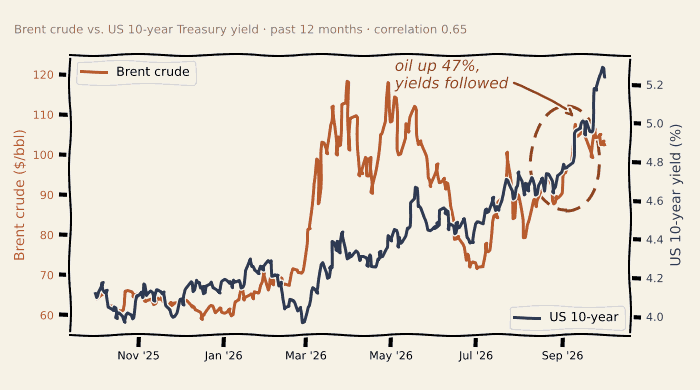 Brent crude vs. the 10-year Treasury yield, past 12 months (correlation: 0.64). Brent is up 47% from last October; the 10-year is up 114 basis points. That's the inflation channel, drawn: oil rallies, yields follow. Flavio's take: your mortgage rate is trading crude futures now. Why Oil Prices Show Up in Your Mortgage Rate
It starts at the pump, but it doesn't end there. Oil is the cost of moving things: diesel for trucks, fuel for planes and ships, so when crude rises, the price of nearly everything transported rises with it. That seeps into inflation numbers, and the Federal Reserve watches inflation like a hawk: hotter inflation means rates stay higher for longer. Higher rates push Treasury bond yields up. The 10-year is at 5.33%, and mortgage rates, corporate borrowing costs, and the math behind stock valuations all follow it. So a barrel of crude in the desert can, a few steps later, decide what your mortgage costs in Miami. Flavio's take: watch what oil does before you watch what the Fed says. FEATURED READS★ THE ELECTION READ
With the midterms five weeks out, the Spread runs one election read per week through November, chosen for balance across the aisle. The debut: Where Senators Sit Can Shape How They Vote
HBS Working Knowledge · ~8 min read
Thirty years of Senate roll-call votes, about a million of them, show that persuasion has a seating chart. Freshman senators draw the worst desks by lottery, and the colleagues around them shape their votes: sitting next to senators voting "yes" lifts a newcomer's own chance of voting yes by 10–12 percentage points. The effect grows in year two, lingers six years after the neighbors move on, and, the kicker, the chamber's most extreme members exert four times the pull of moderates. A House office lottery confirms the pattern: better-placed offices meant up to 25% more party-defying votes on close calls. Location isn't just real estate. It's influence. Read the article →Flavio's take: makes you wonder how many "convictions" in Washington are really just seating arrangements. Less for More
Prof G Media (Scott Galloway) · ~8 min read
Galloway on why American health insurance is a fear business. Employer premiums are projected to rise 11% this year, the steepest jump in two decades and triple the rate of inflation, while workers pay 8% more out of pocket. His argument: subsidizing demand without fixing supply just pours fuel on the flame. Between 2011 and 2024, premiums rose almost dollar-for-dollar with health spending, and insurer markups actually fell. The fix, borrowed from the Niskanen Center: more. More doctors, more clinics, more competition. Kill the private insurance subsidies and embrace what he calls Medicare for More. Read the article →Flavio's take: we spend 18% of GDP on healthcare, twice the OECD average, for worse outcomes. The villain isn't drug prices. It's the shortage of doctors. AI Boom Shields Stocks From G7 Bond Bear Market
Seeking Alpha (Jefferies) · ~3 min read
Jefferies on the market's split personality. A sharp drop in US consumer confidence points to a midterm rout for Republicans, with prediction markets shifting toward the Democrats. But stocks don't care: AI-driven corporate earnings, especially in tech and semiconductors, are shielding equities from the G7 bond bear market and rising yields. The other trade working: emerging-market local-currency bonds keep beating G7 government bonds, and Jefferies expects that outperformance to continue. Read the article →Flavio's take: earnings are the shield. As long as the AI capex keeps flowing, stocks can take higher yields. September Macro Letter: "The Tug of War"
The Weekend Spread
Each month I write a macro letter around my proprietary Income Cascade portfolio, a rules-based options strategy on the Nasdaq 100. It holds long-dated QQQ calls for upside, sells a short-dated call every month to collect premium as income, and keeps a wall of puts underneath as downside defense. One number, the gap between Nasdaq and S&P implied volatility, sets how much exposure it carries overnight. Fully mechanical: no forecasts, no gut calls. September's letter is about the tug of war pulling this market in opposite directions as we head into year-end: strong earnings on one side, higher rates and year-end caution on the other. Read the September letter →Flavio's take: growth won the round. The trick now is keeping the winnings. PODCAST PICKSWhy Markets May Be Pricing in Too Many Fed Rate Hikes
Goldman Sachs Exchanges
Allison Nathan with Rob Kaplan, Goldman vice chairman and former Dallas Fed president. Kaplan's view: the September hike under new chair Kevin Warsh was the right call, but markets are now pricing in more hikes than the Fed will likely deliver. The 10-year is above 5%, oil is near $100, and the AI buildout does not care about the fed funds rate. Worth a listen before the October meeting. Listen →Cleopatra (4-part series)
The Rest Is History · ~42 min each
Tom Holland and Dominic Sandbrook on Cleopatra, the last pharaoh of Egypt, who nearly beat Rome. All four episodes, in order. Perfect company for the Egypt section above.
Part 1: Young Cleopatra Flavio's take: one for the week in markets, one for the Egypt daydreams. FOLLOW UP: MICRON EARNINGSMU: THE CASH MACHINE $68B net cash, more than Apple or NVIDIA $85B earned this year, three-quarters of Apple's profit, at a fifth of the market cap. P/E ~24 vs 38 for Apple and 29 for NVIDIA. Fifth straight record quarter. Revenue $54.23B (Wall Street expected ~$51B), adjusted EPS $33.42, gross margin 87%. Guidance for next quarter: revenue $61.5B ± $1.5B, EPS $38.15 ± $1.00. But the number my whole thesis hinged on was capex: as long as the AI buildout keeps spending, earnings stay strong. Twenty-six strategic customer agreements now cover ~35% of revenue through 2030, with $32B in customer financial commitments behind them. Rosenblatt raised its price target to $1,900. The morning after, the stock is up. The usual sell-the-news didn't stick. Next catalyst: December 9, when the CHIPS Act buyback restrictions come off. Cramer said this morning that Sanjay Mehrotra will come on CNBC to announce the buyback, and he expects it to be bigger than Nvidia's. The CFO already said they will ask for a bigger authorization and return 100% of excess cash to shareholders over time. Cantor thinks it could run $300 to $400 billion over two years. Flavio's take: solid entry point. The bear case is that memory is cyclical and always looks cheap at the peak. The difference this time is where the demand comes from: last cycle it was consumer electronics through layers of distributors. Now it is data centers buying direct on pre-paid take-or-pay contracts. My full Micron thesis — why I own it, the three price targets, and the trade structure → Watch: Sanjay Mehrotra on CNBC's Squawk on the Street (4 min) MONEY AND INVESTING 101: MONTH 1 IS LIVE"Pay Yourself First." Month 1 of the twelve-month program, designed for college kids and young adults, is out, built around The Richest Man in Babylon. The core rule: invest 10% of your net income, minimum: starting now, while your money stays liquid. Two phases: while you're building a 3–6 month emergency buffer, split the 10%, half into the market from day one (SPY/QQQ), half into the buffer. Once the buffer is full, the whole 10% goes to investments. Every dollar you earn lands in one of three buckets: Bills (keep as small as honesty allows), Safety (six months of expenses, liquid and interest-bearing), Growth (capital at work). The road ahead: Ramit Sethi, Helaine Olen & Harold Pollack, Dave Ramsey, David McKnight, Morgan Housel, Charlie Munger, Robert Hagstrom, Peter Lynch, Joe Duarte, Ethan Mollick, and Scott Galloway, one book a month, ending where it all points: IR > E = FF. When your investment return beats your expenses, you're free. Flavio's take: money is what you get from the work you deliver. If you exchange time for money, you'll never get off the hamster wheel. TRAVEL: EGYPTAn occasional section, only when I have something real to share. This week: Egypt, from a recent trip.  Sleep: Marriott Mena House, Giza The pyramids rise over the hotel gardens: you have breakfast looking at 4,500 years of history. Highly recommend it. Sail: the Nile Adventurer, an A&K Sanctuary Four nights between Luxor and Aswan aboard a 32-cabin riverboat with an Egyptologist on board, the ship Harvard Alumni Travel uses on its Egypt & the Nile program, and the one I sailed on. See the ship → 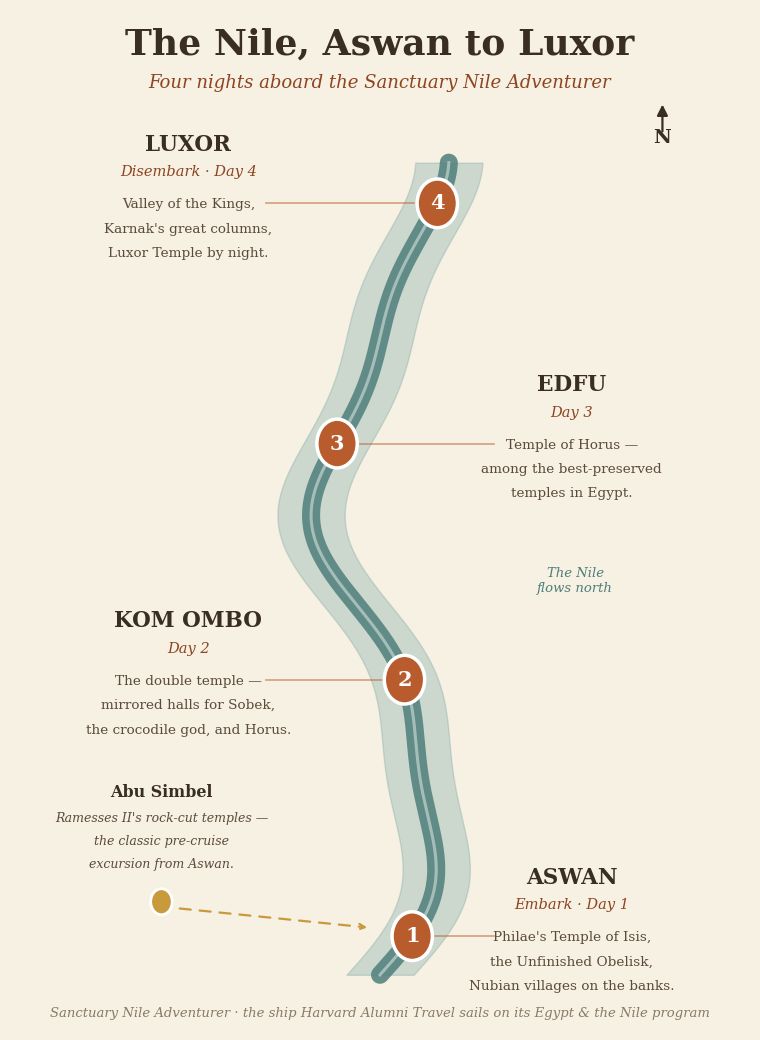 The route, Upper to Lower Egypt (south to north): Aswan: the granite quarries and Philae Temple, saved stone by stone from the rising Nile. Kom Ombo: the double temple, half for the crocodile god Sobek, half for Horus the falcon. Edfu: the best-preserved temple in Egypt, a Ptolemaic time capsule. Luxor: Karnak's forest of columns and the Luxor Temple glowing at dusk. Side excursion: Abu Simbel: Ramses II's colossi, moved in the 1960s to escape Lake Nasser. 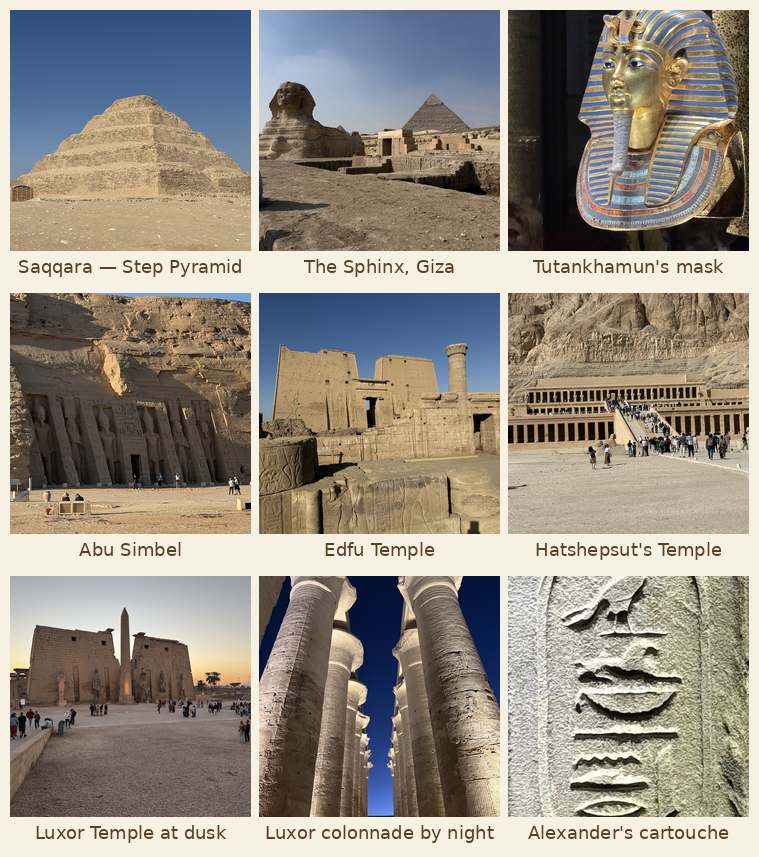 From my camera roll, nine stops that stayed with me. Insure: Ripcord by Redpoint I used this insurance on my recent trip to Egypt. Up to $1M in medical evacuation, search-and-rescue coverage, trip cancellation and interruption, with a cancel-for-any-reason option. redpointtravelprotection.com/plan/ripcord/ Flavio's take: Egypt is a trip, not a tour, go with a good ship, good insurance, a good guide, and a hotel where the pyramids are the wallpaper. I took the Harvard family trip, Egypt & the Nile Family Adventure, and it delivered. WHAT I'M LISTENING TO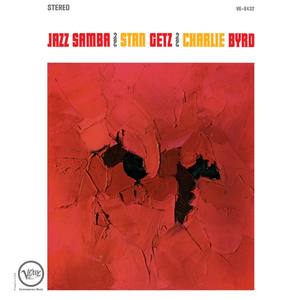 "Desafinado", Stan Getz & Charlie Byrd, from Jazz Samba (1962), the record that brought bossa nova to America. Bossa nova's beautiful off-key shrug, cool, breezy, and slightly out of tune on purpose. Listen → THIS WEEK'S ASSIGNMENTFind the interest rate on your mortgage and write it next to 7.28%. That is today's average 30-year rate, after the biggest weekly jump in four years. If your number is lower, the gap is cash you keep every single month. Know your number. It is the one the market is repricing. FRIDAY CLOSE SNAPSHOT
Friday, October 2 closes. Vol levels approximate, as of Saturday morning. VIX/VXN = expected volatility for the S&P 500 vs. the Nasdaq. The gap between them (~6.3) is how much extra turbulence traders expect from tech stocks. THE WEEK AHEAD
Monday: ISM services survey, the temperature check on the services economy. Flavio's take: Wednesday's minutes are the only appointment that matters. THE WS HAS A NEW HOME The Weekend Spread now lives at theweekendspread.com, every edition, the monthly macro letters, Money and Investing 101, and the HBS corner, all in one place and easy to share. If a friend forwarded you this email, you can catch up on every past edition there. And one small ask: follow us on Instagram · Facebook. New editions, charts, and the occasional photo from the road land there first. One more ask: if you think any of your clever friends would enjoy the WS, forward this to them. MEET FLAVIOI'm Flavio Lobato. I've been investing capital in venture and capital markets for the last 30 years. Earned my chops at Goldman Sachs and later implemented a venture development strategy at Ikove Ventures. I invest my own capital via Lobato Advisory Group, and manage a rules-based options strategy on the Nasdaq 100. I graduated from Harvard Business School. The Weekend Spread is my passion project — markets and ideas. No noise, no sponsors. Hope you enjoy it.
Know someone who'd enjoy this? Forward it to a friend. © 2026 Lobato Advisory Group LLC. All rights reserved. | |||||||||||||||||||||||||||
|
Was this forwarded to you? Join the list below to get it every Saturday.
Get The Weekend Spread
One personal letter every Saturday morning. Enter your email address to join the list.
You’ll see a confirmation right here.
Prefer email? Write to weekendspreadnewsletter@gmail.com with the subject “New Weekend Spread subscriber”.
| |||||||||||||||||||||||||||
|
The Weekend Spread
A personal weekend edition. Not investment advice.
|