The trade I am building
I am building a position in Micron through a call spread. The long call is deep in the money at 0.70 to 0.80 delta so it behaves like the stock. The short call starts at my first target of $1,300 in six months. As each target approaches and the thesis remains intact, I roll it up to the next leg.
Micron is the most inexpensive stock on the Nasdaq 100. Micron is the value and memory leverage. The market sees another memory cycle. I see a toll road with most of next year’s output already spoken for.
The quarter that reset the debate
Fiscal fourth quarter revenue reached $54.23 billion, up 379% from a year ago. Adjusted earnings were $33.42 a share. Gross margin reached 87%, up from 45.7% a year earlier. The company generated $33.2 billion of free cash flow in the quarter alone.
The $54 billion quarter
Full year revenue was $133.2 billion, up 256%, with $75.52 of adjusted earnings per share and $62.3 billion of free cash flow. The next quarter guide is $61.5 billion of revenue, plus or minus $1.5 billion, and $38.15 of earnings per share, plus or minus $1.00. Management expects revenue to grow sequentially in every quarter of fiscal 2027.
Inexpensive in plain numbers
At the $1,075 price reference, Micron trades at about 6.8 times fiscal 2027 consensus earnings of $158. The Nasdaq 100 trades around 31 times. Micron’s PEG is 0.06 versus about 1.3 for the Nasdaq 100. That is growth for pennies on the dollar. Micron is growing revenue nearly fourfold year over year, printing 87% gross margins and selling at less than one quarter of the market multiple.
Most inexpensive on the Nasdaq 100
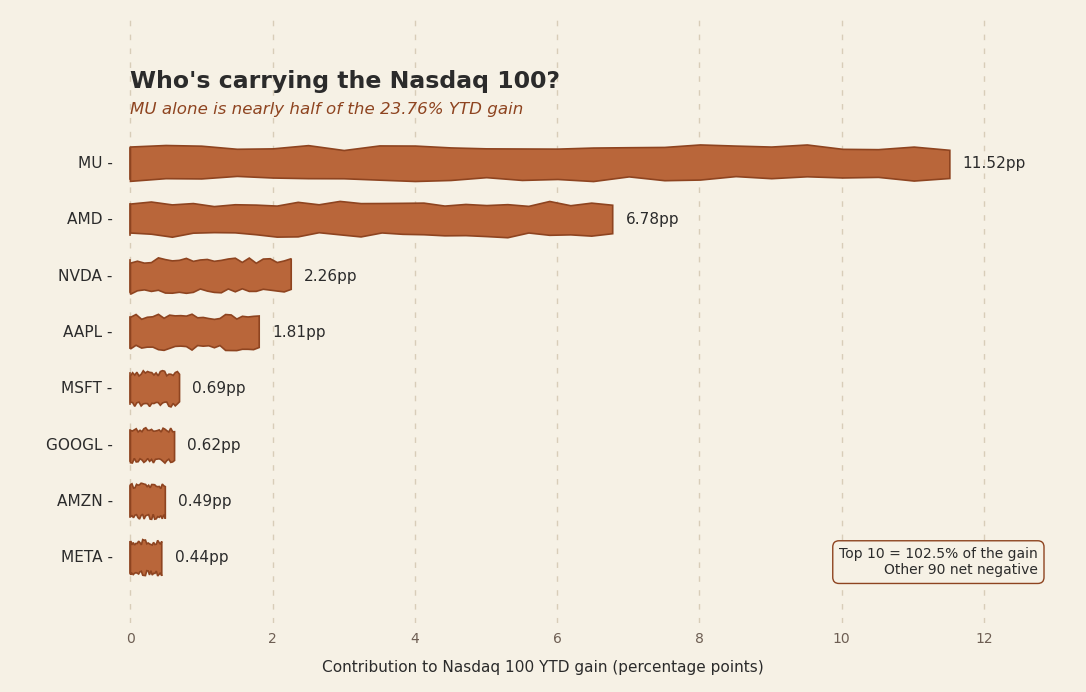
Micron is one of the best performing Nasdaq 100 stocks this year, up 238%, and it has gotten cheaper over the course of the year. Earnings estimates have risen faster than the price. The multiple has compressed even as the stock has run.
Carrying the index
More cash at one quarter the size
Apple and Nvidia are the first and second highest market cap companies in the world. Micron is roughly one quarter of their size, yet its earnings are 75% to 85% of theirs. Then look at the balance sheet: Micron holds $68.3 billion in net cash, more than Apple’s $63 billion and nearly three times Nvidia’s roughly $23 billion.
Micron holds more net cash
That is the inversion. More net cash than both of them, at roughly one quarter the market value. Micron is already earning most of what they earn.
The cycle is now in writing
Micron has signed 26 strategic customer agreements covering more than 35% of revenue through 2030. Those agreements carry $32 billion in customer financial commitments and roughly $150 billion in remaining performance obligations. Every agreement has take or pay volumes.
More than 75% of fiscal 2027 output is already committed. Three quarters of the strategic agreement revenue has a defined pricing framework, mostly floors and ceilings. Management says even the floor prices support margins meaningfully above any prior cycle peak. That does not eliminate cyclicality, but it does make the old spot price and inventory glut playbook less useful.
The December 9 catalyst
The near term catalyst has a date: December 9, 2026. Micron’s CHIPS Act agreements restrict meaningful repurchases until the second anniversary of the agreements. CFO Mark Murphy said stronger capital return begins then. Over time, the company expects to return 100% of excess cash, mainly through buybacks.
The buyback gate comes off
The current authorization has only about $2.2 billion left. Cantor Fitzgerald estimates $300 billion to $400 billion of buybacks over the following eight quarters, potentially the largest stock buyback in history. At a $1.2 trillion market cap, that firepower could remove about a third of the float. UBS models $380 billion to $400 billion of cumulative free cash flow through the end of 2028. Those are analyst estimates, not company guidance. The dated fact is the restriction lifting and management’s stated plan to return excess cash.
Three targets, three legs
My first price target is $1,300 in six months. The second is $1,500 in twelve months. The third is $1,700 in eighteen months. The $1,300 first leg is about 8.2 times fiscal 2027 consensus earnings of $158. The $1,500 second leg is about 7.3 times my illustrative fiscal 2028 earnings estimate of $205.
On October 8, D.A. Davidson’s Gil Luria raised his Micron price target to $3,000, arguing the AI memory demand cycle supports a far higher valuation than the market assigns. That is well above my third leg. I am not changing my targets, but it is a useful data point: a serious analyst sees the same toll road, just further down it. Watch the CNBC segment →
The structure is designed to move with the thesis. As the stock approaches $1,300 and the thesis remains intact, I roll the short call up to $1,500. As it approaches $1,500 with the thesis intact, I roll again toward $1,700. The target path is set before emotion enters the trade.
The gearing: +180% vs +58%
The structure
March 2027 call spread
The long call gives me stock like exposure at a fraction of the capital. The short call is where the thesis says the stock should go. Its theta should cover the long call’s theta. The spread defines the loss before I enter and forces the price target into the trade.
Five advantages of using this structure.
- Defined risk. I know the max loss at inception.
- No theta bleed. The short call's theta wipes out the long call's theta, so time decay is near zero.
- Vega neutral. Net vega is near zero, so an IV crush can't hurt.
- Pay only for the upside I want. I only pay for upside to my price target, nothing past it.
- Gearing. At 0.70 to 0.80 delta, one option contract controls 70 to 80 shares.
Roll the short call toward $1,500 and then $1,700 as each target approaches and the thesis remains intact.
What could go wrong
- 01Memory could still be memory. If AI demand pauses, pricing power goes with it.
- 02The bar is high. After a huge run, a good quarter can still disappoint the market.
- 03Capex is rising. More than $50 billion of fiscal 2027 spending becomes a problem if new capacity meets softer demand.
- 04Contracts are not immunity. Take or pay terms help, but customer renegotiation and concentration still matter.
- 05China and beta. Semiconductor policy is a permanent overhang, and MU can move roughly twice as hard as the market.
Flavio