State of the Housing Market
The rate did what prices couldn’t. It froze the whole market without crashing it.
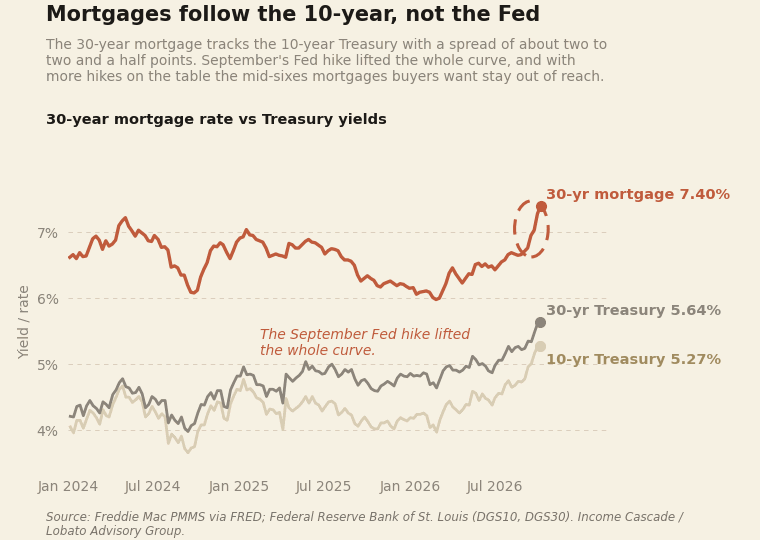
In late February, the average 30-year mortgage briefly touched 5.98%. Seven months later it is 7.40%, per Freddie Mac's October 8 survey. That round trip, up a point and a half, did something unusual: it brought the housing market to a standstill while leaving prices almost untouched.
This is how the freeze shows up, piece by piece.
Buyers walked away
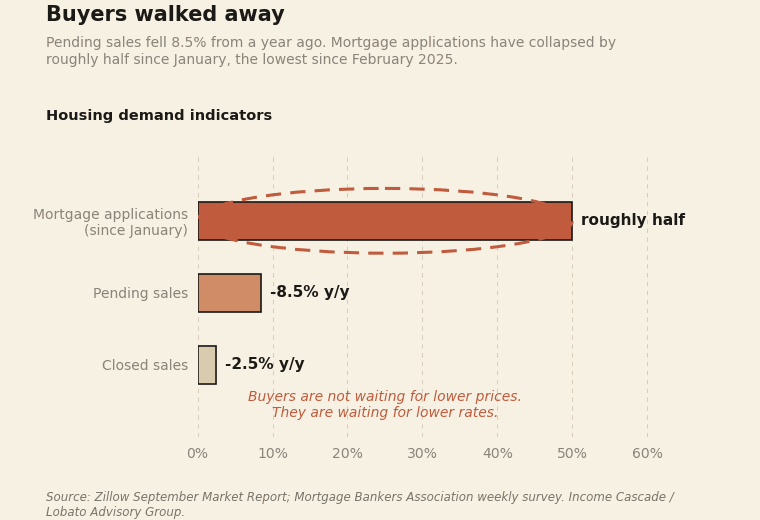
Newly pending home sales fell 8.5% year over year in September, according to Zillow. Closed sales fell 2.5%. Mortgage applications are at their lowest since February 2025 and have collapsed by roughly half since January. Refinancing, which needs rates to fall to make sense, is running at less than half of last year's pace. As one lender economist put it, very few homeowners have any incentive to refinance at these rates.
Buyers are not waiting for lower prices. They are waiting for lower rates. Zillow's chief economist expects sales to stay below 2025 levels through the fourth quarter, with buyers holding out for spring and hoping rates ease back toward the mid-sixes next year.
It is the rate, not the price
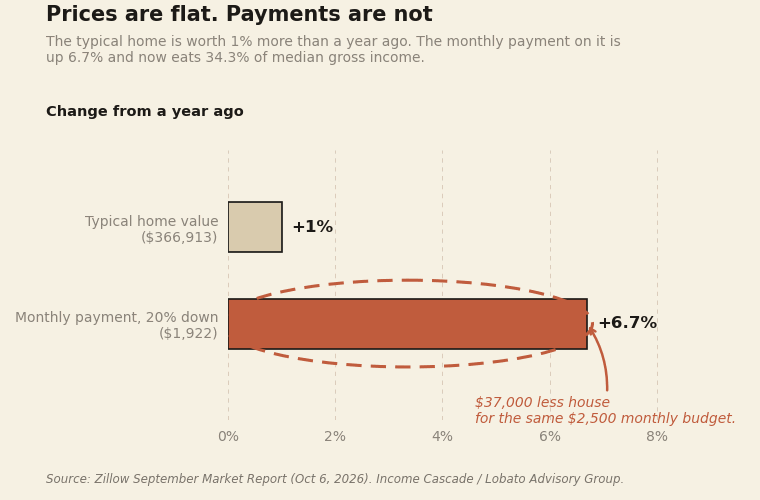
The typical American home is worth $366,913, up just 1% from a year ago. Prices are flat. But the monthly payment on that home, with 20% down, is $1,922, up 6.7% from a year ago. At median household income, the payment now eats 34.3% of gross earnings.
Put it in dollars. A $400,000 loan at 7.49% costs about $2,794 a month in principal and interest. At the 6.1% that prevailed before the spring, it was about $2,424. Same house, $370 more every month. A buyer with a $2,500 monthly budget could borrow roughly $402,000 a year ago. Today that budget covers about $365,000. That is $37,000 less house for the same payment.
Sellers are frozen by the lock-in
Here is the strange part. Inventory keeps rising, up 2.5% from a year ago, the 34th straight month of annual gains. Yet new listings barely budged, up 0.4%, and remain nearly 12% below pre-pandemic norms. Homes are not flooding the market. They are sitting on it: a median 29 days before going under contract, with 27.4% of listings carrying price cuts.
The reason is the lock-in effect. Most sellers are also buyers, and anyone holding a 3% mortgage from 2021 has no reason to trade it for 7.5%. The inventory that exists is stale listings lingering longer, not fresh supply. That is why prices have not fallen: there is no forced selling, just a market where neither side moves.
Builders are cutting, and it is not working yet
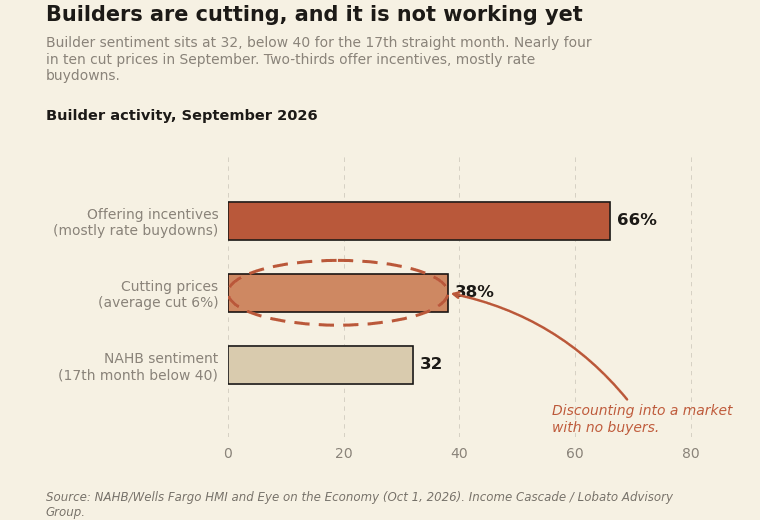
Builder sentiment fell to 32 in September on the NAHB index, the lowest in a year and below the 40 mark for the 17th straight month. Nearly four in ten builders cut prices in September, the average cut holding at 6%. Two-thirds are offering incentives, mostly mortgage rate buydowns and closing cost help, the highest share since December.
It is starting to show in prices. The median new-home sale price fell 5% from a year ago to $393,700. In Sun Belt markets, newly built homes now sell for a lower median price per square foot than existing homes, a remarkable inversion driven by builder incentives and rising inventory.
But the cutting has not restarted demand. Housing starts fell 2.6% in August to a 1.28 million annual rate. Multifamily starts collapsed 21.7%. 2026 will be the second straight year of declining single-family construction, and builders expect 2027 to decline further. They are discounting into a market with no buyers.
Even renting is getting expensive
The escape valve is closing. The typical U.S. rent rose 2.7% in September to $1,932, the biggest annual gain since April 2025, and rent growth has accelerated every month since April across both multifamily and single-family homes. Buyers priced out of purchasing are bidding up rentals instead, which is good news for landlords and bad news for everyone saving for a down payment.
What to watch
The National Association of Realtors releases September existing-home sales on October 13. Freddie Mac's weekly survey lands every Thursday. The question for both is the same: how long can a market stay frozen before something breaks, prices or volumes.
And then there is the Fed. September brought a federal funds rate hike, and with inflation re-accelerating, more hikes are on the table. Mortgage rates do not follow the funds rate directly, they follow the 10-year Treasury, but Fed hikes set the floor under everything. As long as the Fed is hiking, or even threatening to, the mid-sixes mortgage rates buyers are waiting for stay out of reach.
The honest answer is that frozen can last a long time. As long as sellers are not forced to sell, prices drift sideways while transactions dry up. The risk is not a crash. It is a market that slowly stops functioning for anyone who is not paying cash.
Sources: Freddie Mac PMMS via FRED; Mortgage Bankers Association weekly survey; Zillow September Market Report (Oct 6, 2026); NAHB/Wells Fargo HMI and Eye on the Economy (Oct 1, 2026).