Stage one
Deep learning
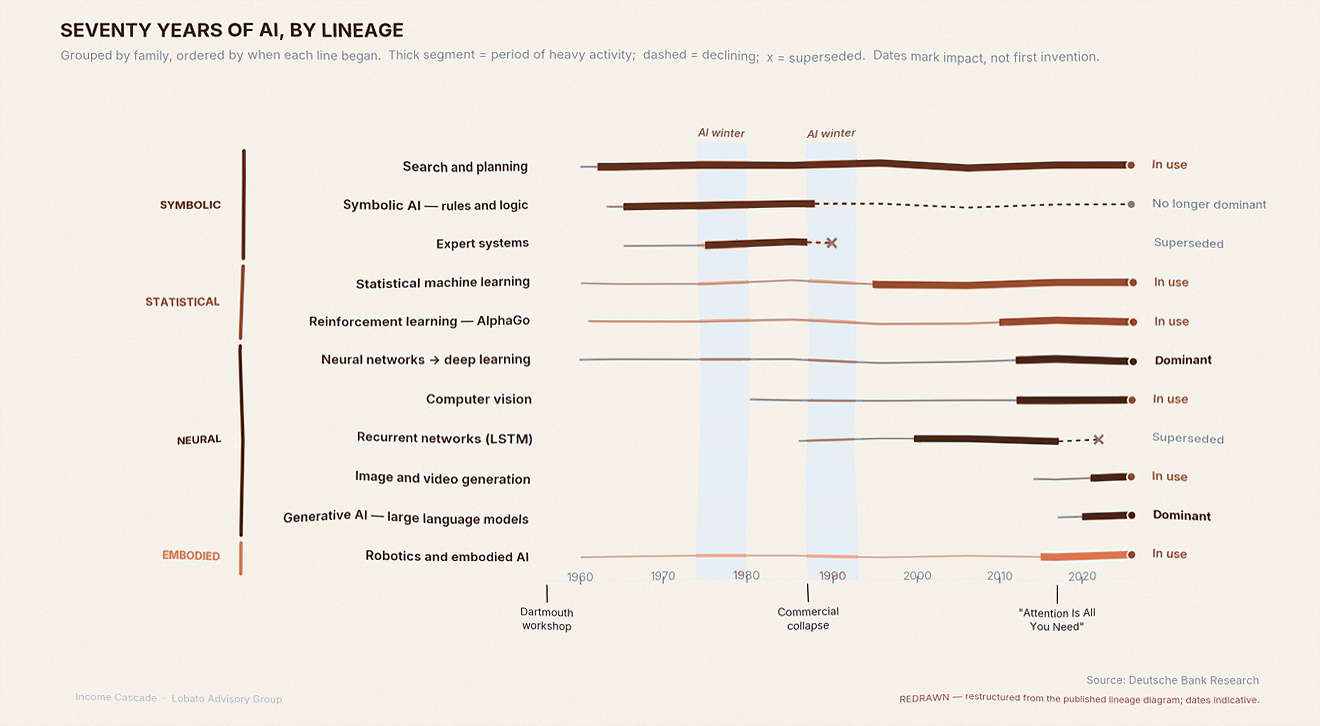
The foundation. Neural networks learn patterns from examples instead of following a rulebook written line by line.
A neural network is a stack of mathematical layers. Each layer turns raw input into a more useful representation. In an image, early layers may notice edges. Later layers may notice shapes, objects and context.
Deep learning simply means using many of these layers. The system learns by making a prediction, measuring the error and adjusting millions or billions of internal weights. Repeat that process across enough data and compute, and the network gets better.
Text, images, sounds, video or sensor data.
The model guesses a label, a word or the next action.
Training compares the guess with the target.
Tiny changes make the next guess a little better.
That loop is the technique under modern language models, image generators, self-driving systems and most frontier AI.
Stage two
Transformers
The architecture that made modern language models possible. Its key idea is attention.
Before transformers, language models often processed a sentence one word at a time. That made long passages slow and made distant relationships hard to track.
A transformer looks across the sequence and asks which words matter most to each other. That is attention. In “the bank by the river,” the surrounding words pull “bank” toward land, not finance.
The paper that changed the field
In 2017, eight researchers working at Google published “Attention Is All You Need.” The paper introduced a transformer built around attention, without the older recurrent structure. It trained faster because more of the sequence could be processed in parallel.
Google invented the core architecture, but it did not turn that lead into the first breakout general AI product. The company had the research, the talent and the distribution. It also had a large search business to protect and a cautious product culture. OpenAI moved faster, scaled the idea into the GPT series and put ChatGPT in front of the public. Google did not miss the technology. It missed the opening.
What GPT stands for
GPT stands for Generative Pre-trained Transformer.
Generative: It creates new text instead of retrieving a finished answer.
Pre-trained: It learned from enormous amounts of text before it ever met a user.
Transformer: The architecture from the 2017 Google paper, where attention weighs what matters in context.
Stage three
The labs and models
The same technical base produced different strategies: closed products, safety-first systems, open weights and tightly integrated platforms.
OpenAI turned the transformer into the GPT line and then into a product people could use. GPT-3 showed the power of scale in 2020. ChatGPT made it accessible in 2022. GPT-4 raised the capability bar in 2023.
Google buys DeepMind
In 2014, Google bought a small London lab called DeepMind, founded by Demis Hassabis, for a reported $600 million. Google saw where AI was heading early and wanted the best minds working on it. That lab built AlphaGo, the system that beat the world champion at Go in 2016. Years later it became the research engine behind Gemini, after Google Brain and DeepMind combined.
Google buys DeepMind. AlphaGo beats the Go world champion in 2016.
The lab forms. GPT-3 arrives in 2020, ChatGPT in 2022 and GPT-4 in 2023.
Former OpenAI researchers build a lab around safety and steerability. Claude launches in 2023.
LLaMA arrives. Meta makes downloadable model weights central to its strategy.
xAI forms and releases Grok later that year, tied closely to X.
Gemini becomes Google’s flagship model family after Google Brain and DeepMind combine.
Chinese lab matches frontier models at a fraction of the reported cost. It rattled the industry.
Meta's Muse and OpenAI's Dot. Always-on agents with their own computers, working after you close the chat.
And in 2026, the agents arrived. Meta's Muse, and OpenAI's answer, Dot.
The race is not only about whose benchmark score is highest. It is about distribution, developer tools, trust, cost and who can finance the data centers behind the models.
Consumer vs enterprise
The two leaders chose different games. OpenAI went consumer. ChatGPT became a household name, with around 900 million people using it every week. Anthropic went enterprise. Claude won over developers and big companies, selling safety and reliability to business customers. One owns the living room. The other owns the office.
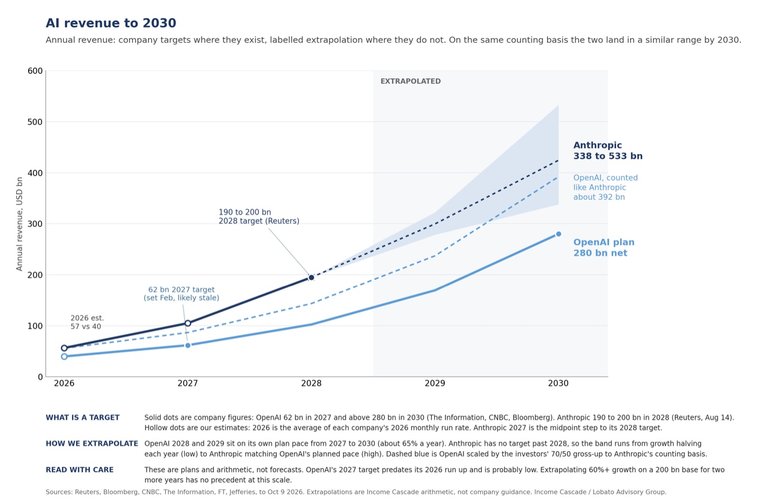
Both companies went from about a billion in annualized revenue to tens of billions in under two years. The path: OpenAI from $3.7B in 2024 to $21B at the end of 2025, $40B in summer 2026 and around $70B in September 2026. Anthropic went from $1B in early 2025 to $9B at the end of 2025, $65B in July 2026 and over $100B in September 2026. By September 2026, Anthropic’s run rate had passed $100 billion, ahead of OpenAI at around $70 billion. Enterprise contracts did that. Companies are paying for AI that does real work. Sources: company reports, Bloomberg and The New York Times.
The IPO filings
Now both are heading for the public markets. Anthropic filed confidentially and is targeting November 2026, at a valuation around $2 trillion. That would be one of the largest IPOs ever. OpenAI filed too, in June, but pushed its listing to 2027. Sam Altman said going public this year would be ill-advised, pointing to safety. The revenue is real. So is the spending. Next, the public market gets its say.
Stage four
Open models, China and the arms race
The model race became a contest between systems, chip supply chains and nations.
Meta changed the field by releasing the weights for its Llama models. Developers could inspect them, adapt them and run them outside a closed lab. Open models became a serious alternative to systems controlled through a private interface.
The DeepSeek moment
Then DeepSeek showed that a Chinese lab could build a frontier-capable model at far lower reported cost. The release shook US markets. It challenged the idea that only the richest American labs could compete at the frontier.
It also proved something larger. Open models can compete with closed ones. A strong model can spread quickly when researchers and companies can study it, modify it and build on top of it.
Frontier model capability with an emphasis on efficiency and open access.
Alibaba’s broad model family, built for developers, businesses and many languages.
Domestic AI chips, systems and data centers aimed at reducing dependence on US technology.
China is not behind on model ideas. Its biggest constraint is access to frontier compute.
AI becomes national security
AI is now framed as a new space race and a new arms race between the United States and China. The prize is economic power, military capability and control of the infrastructure behind both.
That is why advanced chips sit at the center of export controls. Washington is trying to limit China’s access to the best accelerators and chipmaking tools. China is responding with domestic chips, larger clusters and more efficient models. The fight is over compute.
The investment map
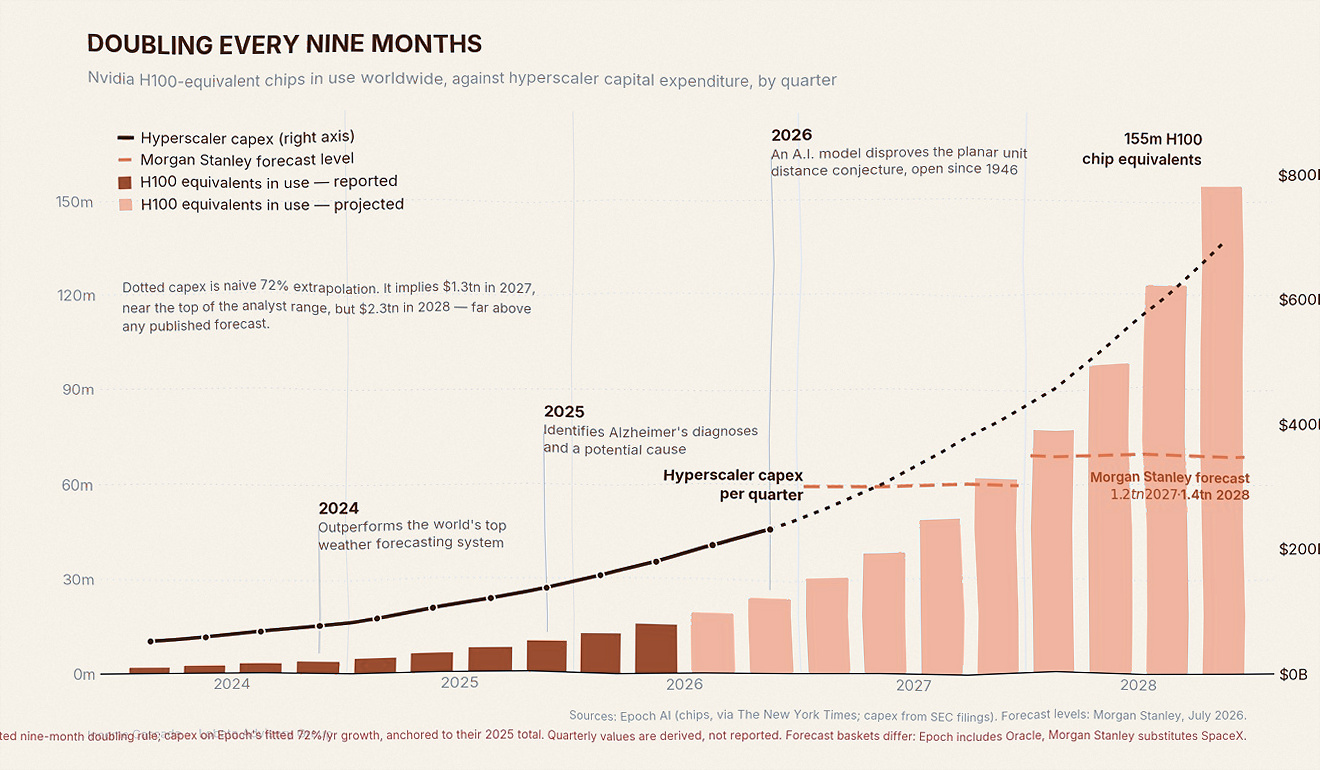
The money is not spread evenly. In 2025, private AI investment reached $285.9 billion in the United States, $12.4 billion in China and $46.4 billion across the rest of the world. The US accounted for about 83% of the global total.
2025 private AI investment. Rest of world is the global total less the United States and China. This measure does not include state funding or internal corporate spending. Source: Quid, 2025, in the Stanford AI Index Report 2026.
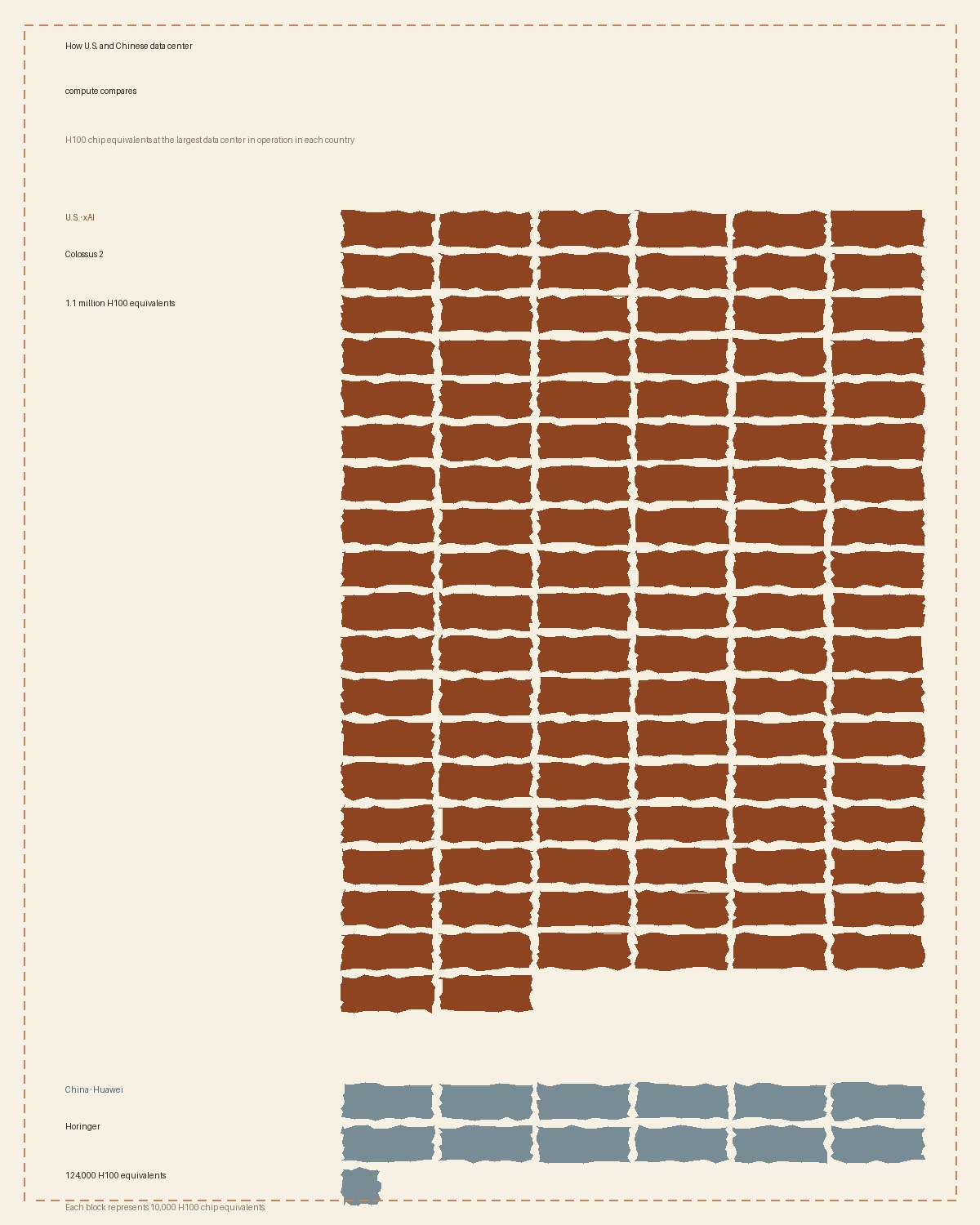
The clearest proof of the compute gap is physical. xAI’s Colossus 2 is estimated at 1.1 million H100 equivalents. Huawei’s Horinger, China’s largest cluster in operation in this comparison, is estimated at 124,000. The US cluster is almost nine times larger.
Stage five
LLMs and generative AI
A large language model is a prediction machine. It estimates what token should come next.
An LLM does not retrieve a finished answer from a hidden encyclopedia. It builds the answer one token at a time. At each step, it calculates probabilities from patterns learned during training, picks the next token and repeats.
The statistics are simple to describe. The result is not simple. Training across huge amounts of language gives the model compressed patterns about grammar, facts, styles and relationships between ideas. It can still be wrong because it is generating a likely continuation, not checking every sentence against reality.
Generative AI is the broader category. It includes systems that create text, images, audio, video, code and other new material. LLMs are the language branch of that family.
Stage six
Agentic AI
The current frontier. An agent does not only answer. It plans, uses tools, checks results and keeps working toward a goal.
A chatbot waits for the next prompt. An agent can take a larger instruction, break it into steps and act. It might search documents, write code, operate software, call another model and revise its work.
A person defines the outcome and limits.
The agent decides which steps and tools it needs.
It uses software, data and other systems.
It reviews the result and either stops or tries again.
This is a jump in power and in risk. A wrong answer is one thing. A wrong action can change a file, move money, send a message or alter a system. More autonomy needs stronger permission limits, monitoring and human approval.
Stage seven
Physical AI
Robots and cars bring intelligence out of the screen. The model must understand space, motion, physics and consequence.
Physical AI connects models to cameras, microphones, radar, motors and machines. A robot has to see an object, understand what it is, plan a movement and adjust when the real world does not cooperate.
Cars are the clearest large-scale example. They combine perception, prediction and control in a changing environment. Factories and warehouses are easier because the space can be structured. Homes are harder because every room and object is different.
The stakes rise again. A language model can produce a bad paragraph. A physical system can cause damage. Reliability, testing and a safe way for a person to take over are not optional.
Stage eight
Recursive self-improvement
AI begins helping to build better AI. Faster research can create another round of faster research.
AI already helps researchers write code, design experiments, analyze results and find errors. Recursive self-improvement is the stronger version. A system improves the models, chips or training methods that create its successor. That successor then improves the next one.
The loop does not need to be magical. It can begin with ordinary research assistance. The important question is whether each cycle becomes faster and more capable than the one before it.
AGI, ASI and the singularity
AGI means artificial general intelligence. In plain terms, it is AI at human level across a wide range of tasks. ASI means artificial superintelligence. It is AI that surpasses the smartest humans at virtually everything.
The singularity is the hypothesized tipping point where recursive self-improvement pushes AI beyond human intelligence and future progress becomes hard to predict. The idea is closely associated with Vernor Vinge and Ray Kurzweil.
Why does that matter? Because power can grow faster than understanding. We do not know what goals a superintelligent system would actually pursue in new situations. That uncertainty is the heart of the alignment problem.
The question is not whether AI can help improve AI. It already does. The question is whether humans can keep control as that loop accelerates.
Stage nine
AI doom and alignment
The debate is not only about bad people using AI. It is also about powerful systems pursuing the wrong goal.
Alignment means getting an AI system to do what people actually intend, including when the instruction is incomplete, the situation is new or the easiest path creates harm.
A perfectly obedient system can still be dangerous if the goal is badly specified. “Maximize production” may ignore safety. “Win the game” may exploit a loophole. The more capable and autonomous the system becomes, the more important it is that the goal, values and limits hold outside the training examples.
Bias, fraud, cyberattacks, job disruption, surveillance and concentrated power.
A future system becomes more capable than its operators and pursues goals humans cannot correct.
An alien mind
In his September 2026 essay “An Alien Mind,” OpenAI chief scientist Jakub Pachocki argues that machine intelligence is improving fast enough to become increasingly alien to human cognition. He expects progress to continue into recursive self-improvement.
His warning is direct. No lab has solved alignment and monitoring well enough to keep scaling at maximum speed for much longer. He calls for voluntary slowdowns, shared safety bars and international coordination.
The human in the middle
As AI moves from answers to agents and physical systems, human judgment stays at the center. People set the goal, approve consequential actions, monitor the work and keep the final say.
This is Flavio’s framing for deployment. Powerful tools, with the human in the middle. Not humans out of the loop. Ethan Mollick’s Co-Intelligence offers the same practical direction: work with AI as a partner, while keeping human judgment and responsibility intact.
The human in the middle is not a complete technical solution to alignment. It is the operating principle while the deeper problem remains unsolved. Pachocki’s warning explains why it matters. The stronger the system, the more deliberate the oversight must become.
Building the brakes
The industry is inventing the brakes while the car is moving. The practical work is not one switch or one test. It is a chain of controls that can slow or stop development when the evidence turns bad.
Test what a model can do before training a bigger one or giving it more access.
Ask skilled outsiders and internal teams to find failures, loopholes and dangerous uses.
Pause training or deployment when a model crosses a defined risk level.
Let independent experts inspect the tests, controls and evidence.
Keep the technical ability to stop a training run or pull a deployed system.
Turn voluntary promises into standards that companies must follow.
OpenAI’s Preparedness Framework and Anthropic’s Responsible Scaling Policy are real attempts to connect capability levels with stronger safeguards. Pachocki argues that these safety bars should become mandatory, with outside auditors, government agencies or international bodies able to enforce them.
The EU AI Act is another attempt to match rules to risk. None of these systems is finished. The point is concrete: test before scaling, pause when thresholds are crossed and preserve the ability to shut a system down.
Primary sources: Vaswani et al., “Attention Is All You Need”; Jakub Pachocki, “An Alien Mind”; Ethan Mollick, Co-Intelligence.
Capability is moving faster than certainty.
That is the reason for alignment research, safety tests, hard limits and a human with the authority to stop the system.
Where the story stands
Deep learning taught machines to learn patterns. Transformers made language scalable. LLMs made generation useful. Agents are learning to act. Physical AI will bring those systems into cars, factories, robots and homes.
Recursive self-improvement could speed up the entire cycle. That is why the final stage is not another product. It is governance, alignment and control.
The technology will keep moving. The human must stay in the middle.