Nobody’s Getting Fired.
Nobody’s Getting Hired.
The labor market is frozen solid. That is exactly why the Fed can keep hiking.
The labor market isn't weak. It isn't strong. It's frozen. Layoffs are near 50-year lows, hiring stalled to 29,000 jobs a month, and workers stopped quitting. Nobody is getting fired. Nobody is getting hired. And that freeze is the Fed's excuse to keep hiking.
Nobody is getting fired
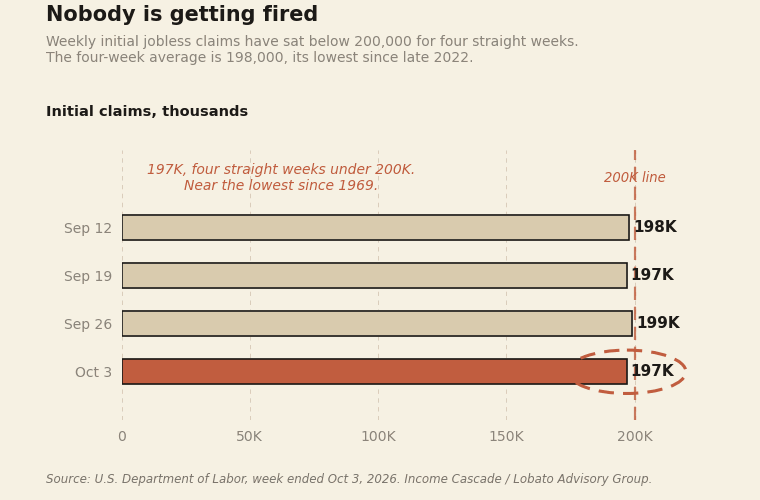
The four-week moving average of claims fell to 198,000, its lowest since late 2022. Before the pandemic era, a sub-200,000 weekly reading was a rarity. This year it has happened eight times.
Employers are hoarding workers. Profits are strong, stocks are near records, and after years of struggling to hire, nobody wants to let people go. As Navy Federal's Heather Long put it, it is a "low-hire, low-fire" market, "great for anyone who has a job and wants to keep it."
The layoff gun is still in the holster. That is what the Fed sees.
Nobody is getting hired
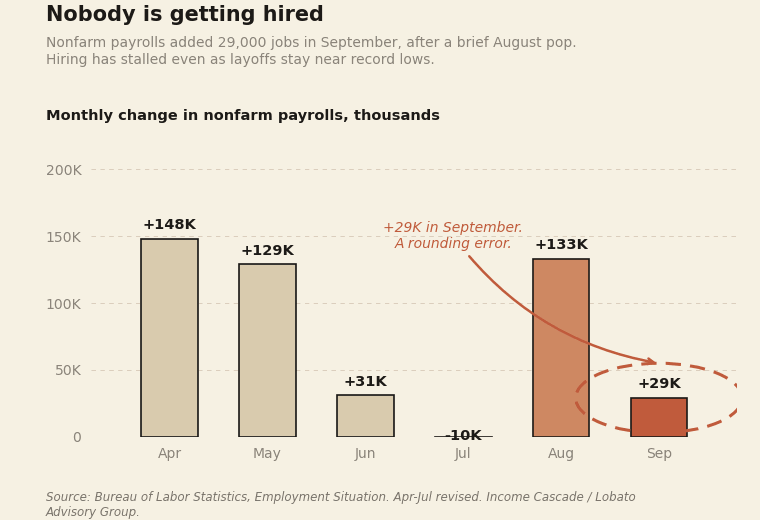
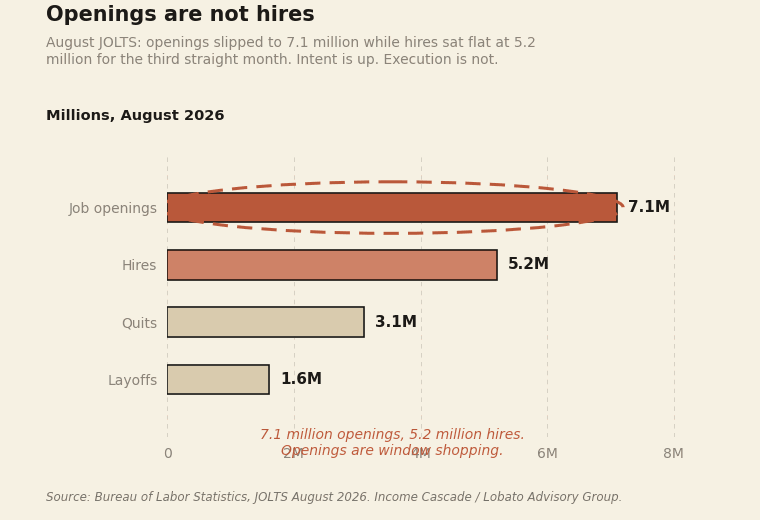
If nobody is being fired, almost nobody is being hired either. September payrolls grew by 29,000, a rounding error in an economy this size. The August JOLTS report showed 7.1 million openings, but hires sat flat at 5.2 million for the third straight month. Openings are window shopping. Actual hiring is not moving.
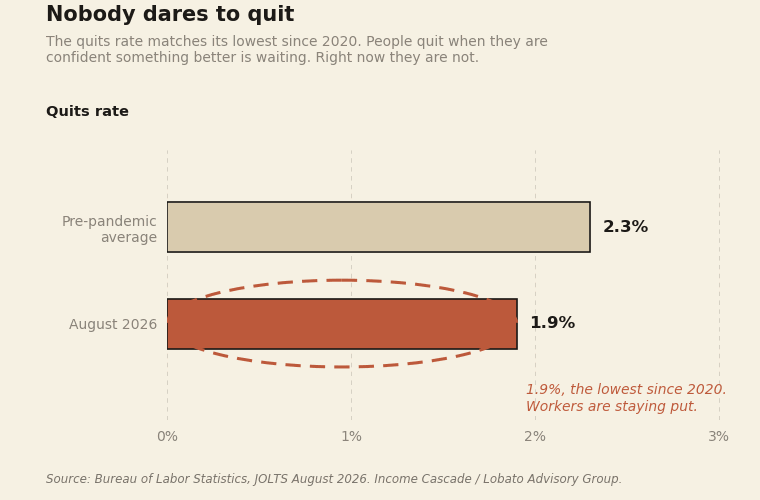
The quits rate tells the human story. At 1.9%, it matches the lowest since 2020. People quit when they are confident something better is waiting. Right now they are staying put, not because they love their jobs, but because they are not sure the next one exists. There is roughly one open job per unemployed worker, down from two at the 2022 peak.
And the early warning light just blinked. Temporary help fell by 10,900 jobs in September, its first decline after eight straight months of gains. Temp workers are the first hired and the first cut. One month is not a trend, but it is the series to watch.
Paychecks tell the same story. Average hourly earnings rose 5 cents in September to $37.81, up 3.0% from a year earlier, the slowest pace since 2021. Workers are not quitting, and they are not getting raises either.
The hiring machine has stalled. The workers know it before the data does.
The ones who already lost
New claims are low. But the stock of unemployed Americans is quietly growing. The unemployment rate ticked up to 4.2% in September. Continuing claims rose to 1.716 million. And the median job search now lasts 11.5 weeks, the longest in more than four years.
This is the split screen of a frozen market. The flow looks fine: hardly anyone new is filing. The stock tells the truth: once you are out, getting back in takes longer every month.
Lose your job in this market and the door back in is narrower than it looks.
Where the jobs are
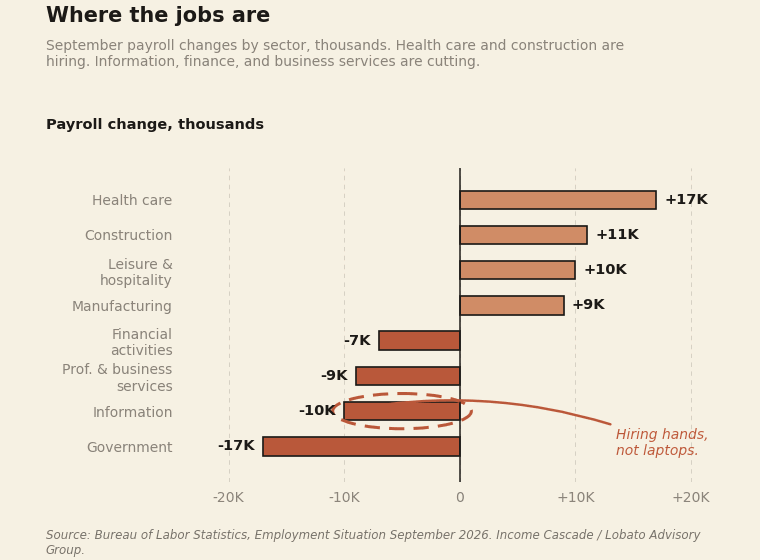
September's hiring was not spread evenly. Health care added 17,000 jobs, construction 11,000, manufacturing 9,000. The hands-on economy is still hiring.
The white-collar economy is not. Information shed 10,000 jobs. Professional and business services lost 9,000. Financial activities lost 7,000, part of 129,000 gone since May 2025. Government cut 17,000.
The pattern is clear: the economy is hiring hands, not laptops.
The ladder lost its bottom rung
For young workers, the freeze is a wall. Unemployment for recent graduates aged 22 to 27 runs about 5.6%, well above the 4.2% national rate. Entry-level postings are down roughly 35% since 2023. Of every 50 salaried openings, only one welcomes a candidate with zero experience. Four years ago it was one in 15. Nearly 43% of employed recent grads are underemployed, the highest since the pandemic.
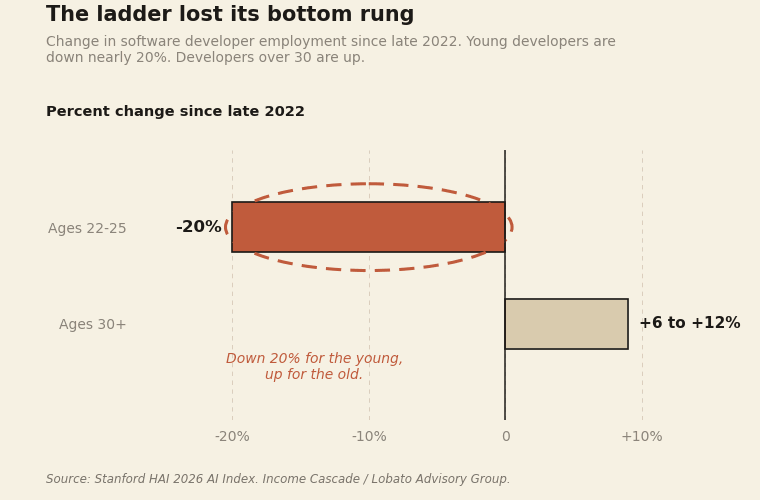
In software, the shift is sharper, and AI is in the room. Stanford's 2026 AI Index found employment for developers aged 22 to 25 down nearly 20% since late 2022, while developers over 30 at the same firms grew 6 to 12%. Entry-level engineering postings are down two-thirds since 2022. Big tech hires about 65% fewer new graduates than in 2019. The junior share of all new engineering hires has fallen from 15% to 7%. In January, Minneapolis Fed president Kashkari said outright that AI is causing large companies to slow hiring, citing "real productivity gains."
The economists argue about how much is AI and how much is plain caution. The hiring numbers do not care about the debate.
AI is pulling up the ladder behind it.
Why the Fed loves this
Read the September FOMC minutes and you will find a central bank with no reason to stop. Officials judged the labor market "close to maximum employment" with risks "broadly balanced." In September the Fed raised rates a quarter point to 3.75-4.00%, its first hike in three years, and flagged more increases ahead.
This is the part most people miss. A weak labor market would force the Fed to choose between inflation and jobs. A frozen one lets it have both arguments at once: employment is at maximum, so it can keep fighting inflation. Low claims are the Fed's permission slip.
A frozen labor market is not a reason to stop hiking. It is the excuse to keep going.
What it means for markets
Follow the chain. A frozen labor market gives the Fed cover to keep hiking, or threatening to. The 10-year Treasury sits near 5.36%, its highest in 24 years. That is the price of money for the entire economy: mortgages, business borrowing, government debt. When it climbs, borrowing gets more expensive for everyone, even with layoffs near zero.
The labor market is not the economy's problem. It is the market's problem.
The takeaway
In the short term, this frozen market is the economy's stabilizer and the market's tormentor. Workers keep their jobs, spending holds up, and the Fed keeps its foot on rates. Watch the thaw for the turn: if claims start climbing, the Fed loses its cover and the hiking stops. If temp help keeps falling, the freeze is turning into something colder. Until then, nobody gets fired, nobody gets hired, and the 10-year does the talking.
Sources: U.S. Bureau of Labor Statistics Employment Situation, September 2026; U.S. Department of Labor weekly claims; BLS JOLTS, August 2026; Stanford HAI 2026 AI Index.