Positioned One Way,
Hedged the Other
Brazil votes on Sunday, and the most honest description of the election is sitting in the options market.
Start with the polls, because they are the least informative part. Flavio Bolsonaro won the first round on October 4 with 47.03% of the valid vote, against 45.16% for President Lula, who is seeking a fourth term at 80. Every final poll of the runoff shows the same shape: Bolsonaro ahead by a little, most of it inside the margin of error. Nexus has valid votes at 50.3% to 49.7%. AtlasIntel has 51.1% to 48.9%. Quaest has 50.6% to 49.4%. A statistical tie with a lean.
Now the money, including how it was positioned before anyone had voted. The polls said tie, but the positioning going into the first round was not a coin flip. Implied volatility on the real ran above 31% for the week of the vote, the highest since late 2022, which said the market knew the event was big. Open interest in the options on the Brazil ETF (EWZ), the exchange-traded fund US investors use to hold Brazilian stocks, hit a record 9 million contracts, and the flow was mostly calls. Citigroup and JPMorgan told clients to position for a stronger real. Two of Brazil's best-known hedge funds, Ibiuna and Verde, told their clients they were set up in options for a stock rally. The market had picked its winner before the polls dared to.
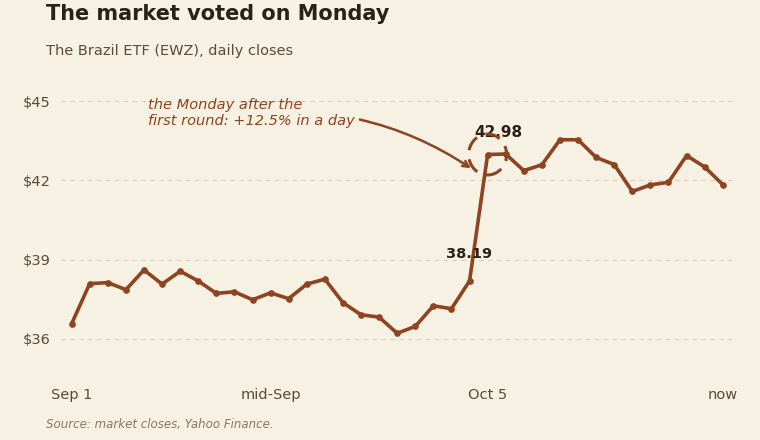
The result paid it. On the Monday after the first round, EWZ rose 12.5% in a day, and the local index rose 8%. This is what that single day did to a fund that had gone nowhere for a month:
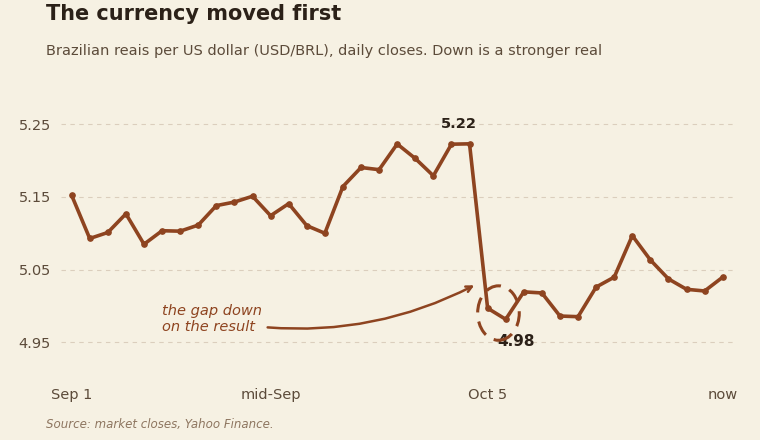
The currency told the same story in one move. The real jumped from 5.22 to the dollar to under 5.00 on the result, and long-term interest rates fell sharply and have stayed lower:
Investors are positioned for Bolsonaro, and for what he is selling: an improvement of 1.5% of GDP in the primary balance within 18 months, a deliberate confidence shock aimed at the cost of Brazil's debt.
The other side of the book is the interesting part. In the options on EWZ and on Petrobras (PBR) this week, implied volatility on the puts is running at about double the calls, and the volume is heavy. One-month hedging costs on the real are at levels not seen since 2011. That is institutional money paying up, in size, for protection against the other outcome. The math explains the price: the dollar-real rate sits near 5.05, a Bolsonaro win might take it to 4.85 or 4.90, and a Lula win moves it much further the other way. When the bad outcome moves more than the good one, insurance gets expensive. Read the two trades separately, because they say different things. The position is the view. Brazilian stocks jumped on Bolsonaro's first-round win and have held nearly all of the gain three days before the runoff. The real is still stronger than it was before the vote. None of that money has been taken off the table, and those trades only pay if he wins, so the book's view is that he does. The puts are not a second, opposite view. They are insurance, bought precisely because the first view might be wrong. The position says Bolsonaro wins, but the hedge says the race is much closer than any prediction.
My own book is positioned in the same hedge, expressed the way this volatility demands: as spreads, not outright puts. With implied volatility this high, a straight put purchase overpays for the event and then loses value to the collapse in volatility on Monday, whichever way the vote goes. The spread sells the lower strike back into the same expensive curve and lets the hedge finance part of itself. On EWZ, long the $42 put and short the $38 put, expiring October 30. On Petrobras (PBR), long the $26 put and short the $22 put, same date. If the first-round rally fully unwinds, each spread pays out roughly three times its cost. If Bolsonaro wins, both expire worthless, and the premium was the price of sleeping on Sunday night. Not financial advice.
What the winner inherits is the reason this matters beyond one Sunday. Brazil's gross debt has climbed more than 10 points during Lula's term, to 82.9% of GDP, and the deficit runs near 10% of GDP. Mandatory spending grows by formula, and the discretionary part of the federal budget, the part a president actually controls, is down to about 7.6% of spending, from 14.2% in 2000. Bolsonaro's campaign has yet to show where his 1.5% comes from, and has promised pensions and welfare stay untouched. Lula promises consolidation at a slower pace that protects lower-income spending. Both men are campaigning on fiscal adjustment without pain, and both have left the structural work for after the vote, which is where it always goes to wait.
Underneath the fiscal divide sits a second one. Lula offers an independent foreign policy, deep trade with China, Brazil's largest trading partner, and a central role in the BRICS. Bolsonaro offers alignment with Washington, where his family is close to President Trump. On Sunday Brazil picks its fiscal path and its patron in the same vote.
Special thanks to Roberto Lobato for showing me the PBR put option discrepancy.