AI Paranoia
Meta was sold because it raised its spending plan. Tesla was sold because it cut its. When both directions of the same decision produce the same trade, the decision is not the information. The mood is.
Meta reported its quarter on Wednesday night. Revenue rose 26%. Its new AI app passed 10 million users in six weeks. The earnings, leaving aside a one-time legal charge, were $7.40 a share against $5.74 expected. The stock rose about 4.2% after hours on Wednesday, to about $727, then gave it all back and more on Thursday, closing at $648.85, down $48.67, or 7.0%, from Wednesday's $697.52 close.
Tesla reported too. It beat, and produced $1.53 billion of free cash flow where the market expected it to burn cash. The stock fell 5%.
Look at why each one fell and the day explains itself. Meta was sold because it raised its spending plan. Tesla was sold because it cut its spending plan. Meta's capital budget for 2026 went from $130 to $145 billion to $135 to $145 billion, adding about $2.5 billion at the midpoint, under 2%. The guide was never the real number anyway. Meta's filing on Thursday put its total future spending commitments at about $825 billion, up about $125 billion in a single quarter. The market spent the day arguing over $2.5 billion. It took roughly $110 billion off Meta's value for it, about 45 times the added spend. Tesla trimmed its plan from over $25 billion to about $20 billion and was punished for slowing down. When both directions of the same decision produce the same trade, the decision is not the information. The mood is.
The mood had help. Oil jumped over $112 after Houthi strikes on Saudi oil facilities and the evacuation of American staff from Saudi missions. Lam Research fell 9% on soft guidance. A downgrade hit CoreWeave, the market's favorite example of AI debt. France's borrowing costs sit at levels last seen in 2011, measured against Germany. None of that is imaginary, and this piece is not going to pretend otherwise.
The stress is real, and you can watch it build in one number. The spread between Nasdaq volatility and broad market volatility is the cleanest stress gauge I know. Here it is, day by day, from the official closes:
| Day | Nasdaq vol (VXN) | Market vol (VIX) | Spread | Nasdaq 100 next day |
|---|---|---|---|---|
| Fri Oct 9 | 20.55 | 14.84 | 5.71 | -0.7% |
| Fri Oct 16 | 27.13 | 19.99 | 7.14 | +1.2% |
| Tue Oct 20 | 25.22 | 17.31 | 7.91 | +1.1% |
| Wed Oct 21 | 24.42 | 16.68 | 7.74 | -2.7% |
| Thu Oct 22 | 28.72 | 19.03 | 9.69 | -0.2% |
| Fri Oct 23 | 28.44 | 19.69 | 8.75 | Monday, to come |
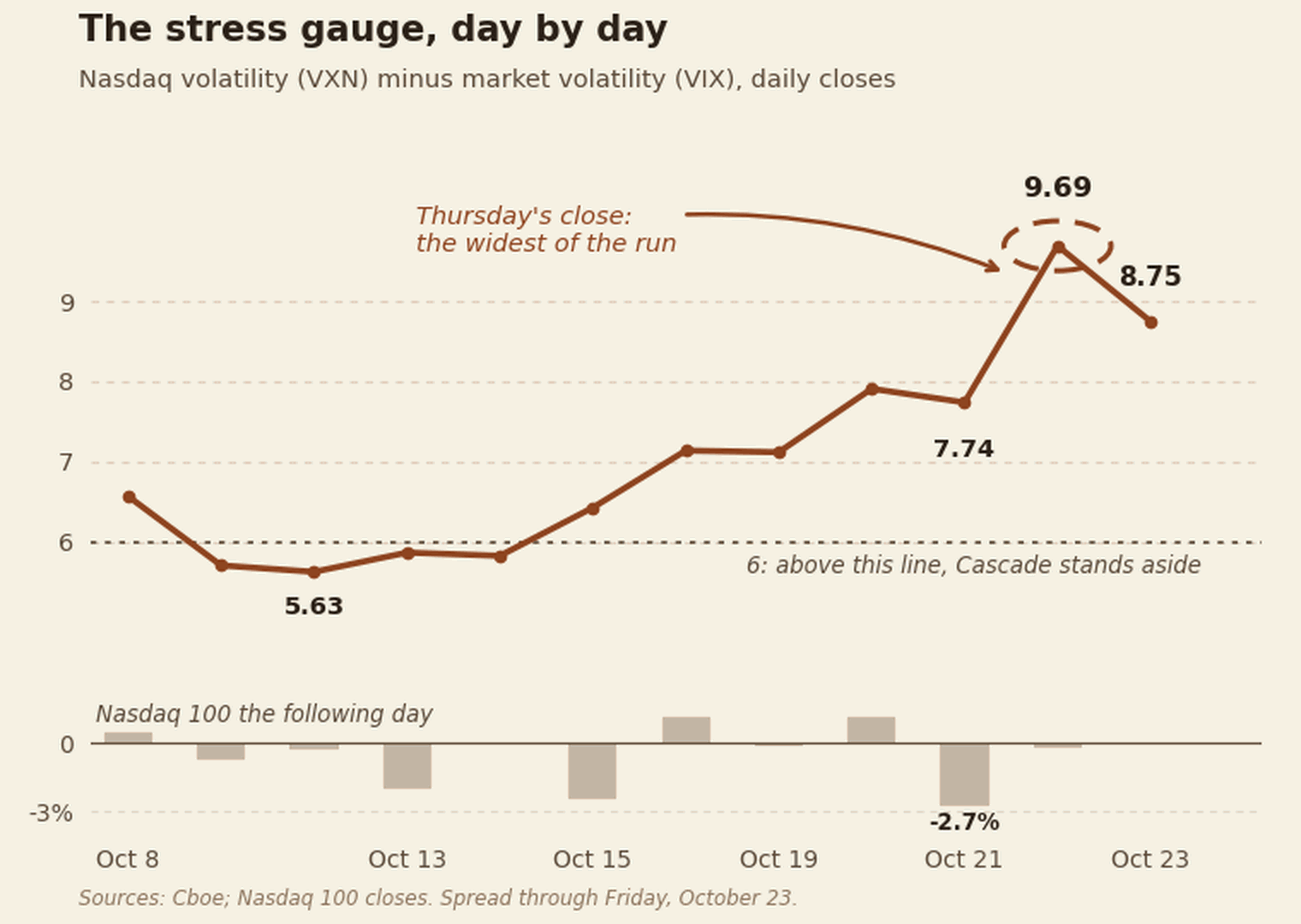
The spread has been wide for a week. It spiked on Friday Oct 16, sat above 7 while the broad market calmed down, and blew out to 9.69 at Thursday's close, with Nasdaq volatility rising just over 4 points against just over 2 for the market as a whole, before easing back to 8.75 on Friday. The fear is specific. It lives in the technology complex, and it was building in the options market days before it arrived in the stock market.
Now set the fear next to the facts. Four analysts raised their Meta price targets on Thursday, the day the stock fell: Mizuho to $950, UBS to $892, Barclays to $880, Susquehanna to $850. In the US, Muse did 10.2 million downloads in its first 40 days, against 3.7 million for ChatGPT in the same window after its launch, and about 25% of the people who set Muse up use it daily. SpaceX reported on Tuesday night: revenue of $14.6 billion, up 161% year over year, net income of $4.4 billion in its first profitable quarter as a public company, its Super Intelligence segment at $7.6 billion, up about 830% and now its largest business, and first quarter 2027 revenue guidance of $33–37 billion against about $22 billion expected. The stock rose about 8% on Wednesday and fell about 6.5% on Thursday in the selloff. IBM reported on Wednesday: revenue of $17.1 billion, up 4.7%, adjusted earnings of $2.95 a share against about $2.86 expected, software revenue up 8.3%, and it raised its full year free cash flow outlook to growth of more than $1 billion and its software growth guide to 7–8%. Its stock fell about 1.25% on Thursday and has not bounced. Earnings season so far has 83% of companies beating, with growth tracking at 25%. Jobless claims printed 194,000, near a 57 year low. And on a day when oil rose 3%, the 10 year Treasury yield fell 12 basis points to 4.99%, its biggest one day drop in over a year. The bond market looked at the same day and bought safety at lower yields. It did not price an inflation spiral. It priced a growth scare inside one sector.
What they say is that AI is on trial. What they do is beat earnings, file almost no jobless claims, download the AI app 10 million times in six weeks, raise price targets on the stock they are selling, and bid for Treasuries. Both things are happening at once. Only one of them is information.
Not financial advice.