The Lab · Financial Crisis Series · Piece 0, the Opener
A Brief History of Financial Crises.
Financial crises are older than banks, older than stock markets, older than paper money. This opener walks four hundred years of them, from a tulip bulb worth twenty years of wages to the panic one rich man stopped from a locked library, and finds the same five acts in every one.
Older than banks
Financial crises are older than banks, older than stock markets, older than paper money. The first one we have a record of hit Rome in the year 33. Land prices fell, credit froze, and lenders called in their loans all at once. The emperor Tiberius had to inject 100 million sesterces into the system to stop the spiral. Two thousand years later, central banks do the same thing with bigger numbers. The machinery changes. The crisis does not.
Here is the short history, and the pattern hiding inside it.
1637: The Flower
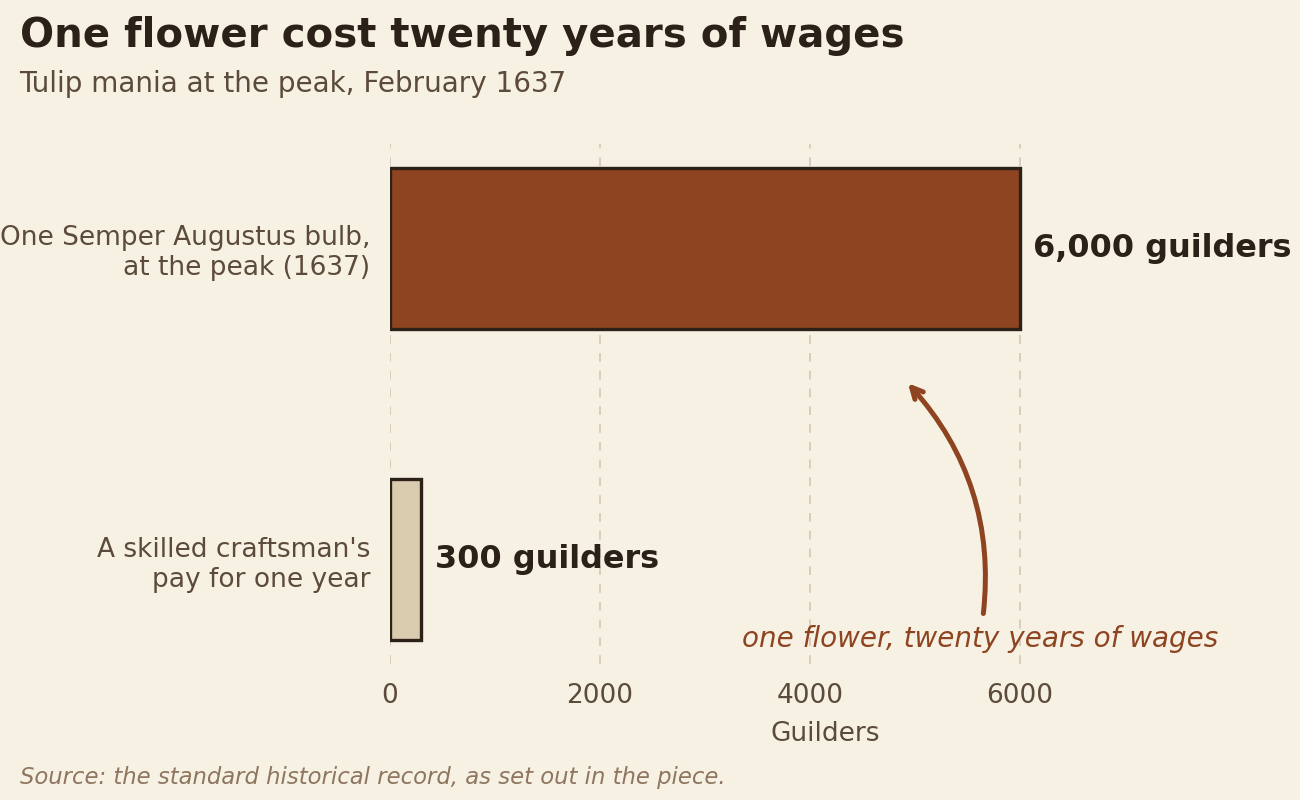
Tulips arrived in Holland from Turkey and became a status symbol, then an obsession. Rare bulbs changed hands for rising prices, and a futures market (buyers agreeing today on a price for delivery later) grew up around flowers still in the ground. At the peak, a single bulb of the most prized variety, the Semper Augustus, reportedly traded for about 6,000 guilders. A skilled craftsman earned about 300 guilders a year. One flower, twenty years of wages. Roughly the price of a fine Amsterdam townhouse.
In February 1637, at an auction in Haarlem, the buyers simply did not bid. Within weeks the market was gone. Some of the tulip numbers that come down to us are part legend, and historians still argue about how much damage the collapse really did to the Dutch economy. But the shape of the event is not in dispute, because we have seen it so many times since. A price that rests on nothing but the next buyer falls the moment the next buyer stays home.
1720: The Twins
Eighty years later, France and England ran the same experiment in the same year, with paper money and national debt added to the recipe.
In Paris, a Scotsman named John Law talked the French state into a grand scheme. His company, the Mississippi Company, would take over the national debt, and its shares would pay the debt off as they rose. They rose from 500 livres to about 10,000 in a year. Everyone in Paris was rich, on paper, until everyone tried to turn the paper back into coin at once. By the end of 1720 the scheme had collapsed and Law had fled the country. France's finances took a generation to recover, and the French word for bank carried a smell for a century.
In London, the South Sea Company ran the same trade in British debt. Its shares went from about 128 pounds in January 1720 to about 1,000 in the summer, then back under 200 by the end of the year. Members of Parliament were inside the scheme. The crash produced one of Britain's first great financial scandals, and some of its first financial regulation.
The lesson of 1720 is the one every later crisis repeats. The fraud and the mania are not separate events. The mania is what lets the fraud grow, and the fraud is what makes the mania look sensible while it lasts.
The fraud and the mania are not separate events.
The 1800s: Every New Machine Gets a Crisis
The nineteenth century set the rhythm we still live by. Railroads, canals, the telegraph: each new technology was real, each one changed the world, and each one arrived carrying a bubble on its back.
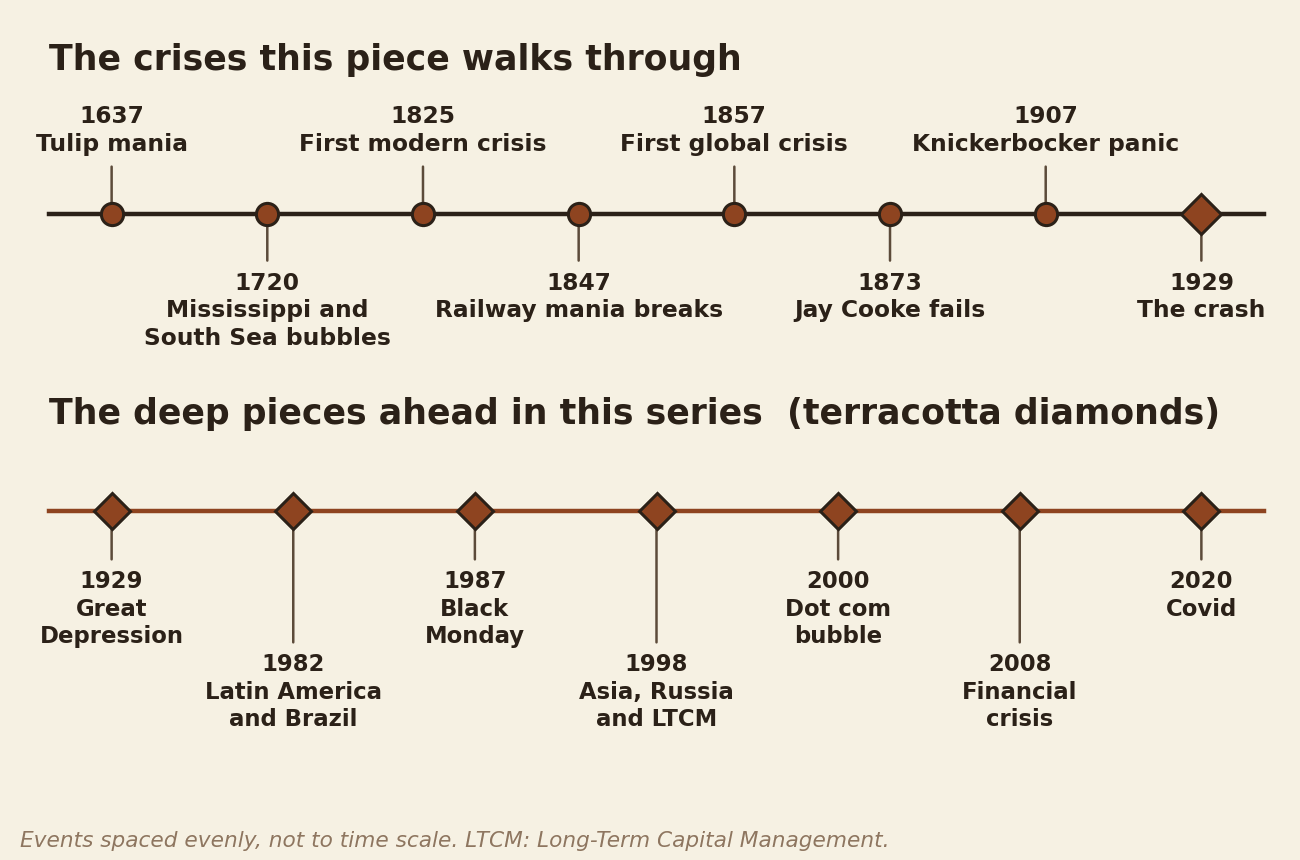
1825 brought what many call the first modern crisis, a frenzy for Latin American loans and country bank notes that nearly emptied the Bank of England's gold. 1847 was the railway mania breaking. 1857 was the first truly global crisis, spread by the telegraph at the speed of the new wires. 1873 began a long depression after a railroad building spree in America, when the great banking house of Jay Cooke failed under the weight of unsold railroad bonds.
Notice the pattern. The technology story is never a lie. Railroads really did remake the world. The lie is only ever in the price and the leverage, the assumption that because the thing is real, any amount of borrowed money thrown at it is safe.
1907: The Last Panic of the Old World
In October 1907, a run started on the Knickerbocker Trust in New York. There was no central bank, no deposit insurance, no lender of last resort. There was only J.P. Morgan, 70 years old, who understood that the system would fall by Monday if nobody acted. He summoned the bankers to his library, locked the doors, and did not let them leave until they had pledged their own money to rescue the trusts. The panic stopped.
The United States decided it could not depend on one rich man's library. In 1913 it created the Federal Reserve. Every central bank rescue since, including 2008 and 2020, is an attempt to do in an orderly way what Morgan did in a locked room.
The Pattern
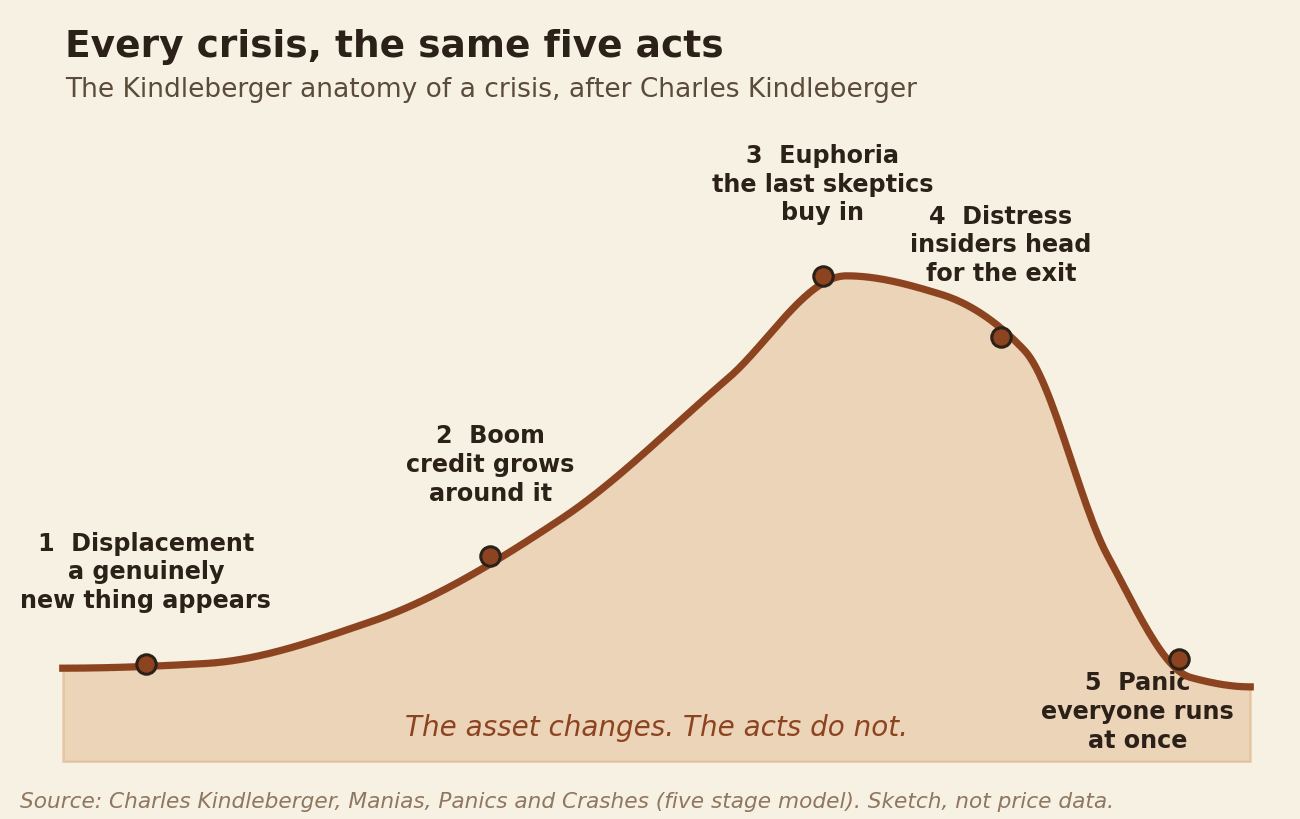
The economist Charles Kindleberger studied four centuries of these events and found the same five acts every time.
First, a displacement: something genuinely new appears, a flower, a trade route, a technology, a financial invention. Second, a boom, as credit grows up around the new thing. Third, euphoria, when the cautious are mocked and the last skeptics buy in. Fourth, distress, when a few insiders quietly head for the exit. Fifth, panic, when everyone else runs at once.
The asset changes. The century changes. The acts do not.
The asset changes. The century changes. The acts do not.
Seven ways the machine breaks
Which is why this series exists. Over the next seven pieces we will take the machine apart, one failure at a time, in the order the world lived them. 1929, where speculation met a central bank that let the money die. The Latin American debt crisis of the 1980s and Brazil in the years I grew up there, where the money itself failed. Black Monday 1987, where the machines sold into themselves. 1998, where three crises on three continents turned out to be one crisis, connected by threads nobody had mapped. The dot com bubble, where great companies carried impossible prices. 2008, where ordinary assets carried impossible debt. And Covid, the shock that came from outside the system entirely, and the cure that planted the next problem.
Different decades, different assets, different countries. Same five acts.
Sources and the numbers in this piece
The machinery changes. The crisis does not.
Different decades, different assets, different countries. Same five acts. The series starts with 1929.