The Lab · Financial Crisis Series · Piece 1
1929.
The crash, and the depression that did not have to follow. A bubble built on borrowed money burst the way bubbles always burst. What turned it into the worst economic disaster in American history was not the crash. It was the choices made after it.
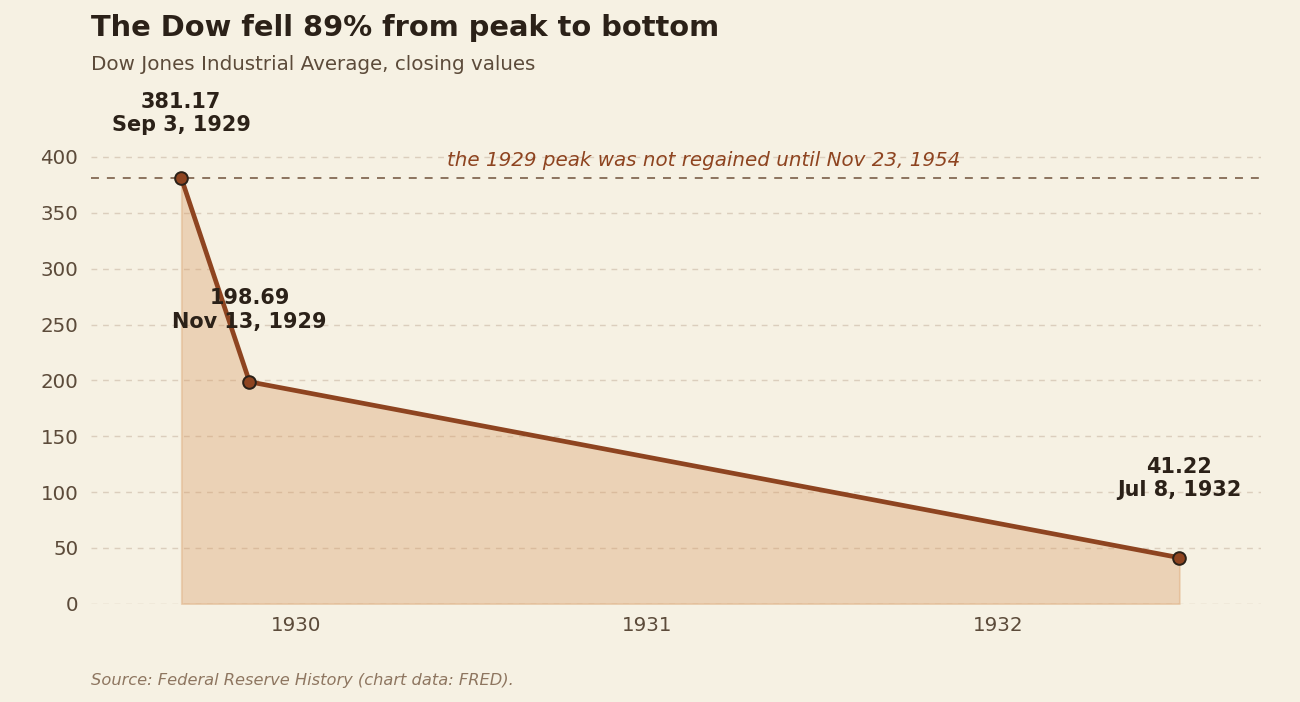
The Dow fell 89% from peak to bottom. The 1929 peak was not regained until 1954.
Two crises, stacked on top of each other
Every crisis in this series gets compared to 1929. There is a reason. 1929 is not one crisis. It is two crises stacked on top of each other, and only the first one was unavoidable.
The first crisis was the crash: a speculative bubble built on borrowed money, and it burst the way bubbles always burst. The second crisis was the Great Depression: three and a half years of bank runs, deflation, and mass unemployment that turned a bad recession into the worst economic disaster in American history. The crash lit the fire. Policy poured the fuel.
A stock market crash did not have to become a depression. This one did, because the people in charge made the wrong choice at almost every turn.
How it built
The 1920s were genuinely prosperous. Cars, radios, telephones, electricity: real inventions, real earnings, a real boom. The stock market rose sixfold from 1921 to its peak. The problem was never that the prosperity was fake. The problem was how people paid for their piece of it.
They borrowed. Buying on margin meant putting down a fraction of the price, typically about 10%, and borrowing the rest from your broker, with the shares themselves as the collateral. Put down $100, control $1,000 of stock. If the stock rose 10%, you doubled your money. If it fell 10%, you were wiped out, and your broker sold you out to protect his loan. By October 1929, brokers' loans, the money lent to people to buy stocks, had reached about $8.5 billion.
On top of the margin sat the investment trusts, the hot new product of the day. A trust was a company whose business was owning stocks. Many trusts were themselves bought on margin, and many owned shares in other trusts. Leverage on leverage on leverage, sold to the public as professional management. When prices rose, the layers multiplied the gains. Nobody asked what the layers would do on the way down.
The Federal Reserve saw the speculation and tried to stop it the blunt way, raising interest rates through 1928 and into 1929. The New York Fed's rate reached 6% in August 1929. The higher rates did not stop the boom. They did help tip the economy itself into recession: the contraction began in August 1929, two months before the crash, and because the world was linked by the gold standard, America's tight money pulled other countries down with it.
On September 3, 1929, the Dow Jones Industrial Average closed at 381.17. It was the peak. Two weeks before the end, the economist Irving Fisher told the country that stock prices had reached what looked like a permanently high plateau. He was the most respected economist in America. He was also heavily invested, on margin.
The bubble was not built on lies. It was built on a true story, real earnings, and other people's money.
The days it broke
The break came in the last week of October 1929. On Thursday, October 24, prices fell so fast that the ticker tape ran hours behind, which meant nobody in America knew what their stocks were worth, only that they were falling. A group of the biggest bankers pooled money and sent a man onto the exchange floor to buy, the way J.P. Morgan had in 1907. It worked for an afternoon.
It did not hold. On Monday, October 28, the Dow fell nearly 13%. On Tuesday, October 29, it fell nearly 12% more, on a record 16 million shares traded. The margin clerks did the rest. Every fall triggered calls for more cash, every customer who could not pay was sold out at any price, and the selling pushed prices down into the next round of calls. The machine that had multiplied gains on the way up now multiplied losses on the way down, automatically.
By mid-November the Dow had lost almost half its value. Then, remarkably, it climbed back. By the spring of 1930 it had recovered much of the ground, and plenty of serious people declared the storm over. They were wrong. The stock market was only the first crisis. The second one was already forming, in a quieter and far more dangerous place: the banks.
The crash destroyed wealth. What came next destroyed the money itself, and that is a different order of disaster.
The second crisis: the Depression
America's banks were fragile in a way that is hard to picture now. Thousands of small banks, many tied to a single town or a single crop. No deposit insurance: if your bank failed, your savings were simply gone. And the Federal Reserve, the institution created after 1907 precisely to stop bank panics, had convinced itself that its job in a panic was mostly to stand back and let weak banks die. Bad banks failing would clean the system, the thinking went. It was called liquidationism, and it mistook a fire for a cleaning.
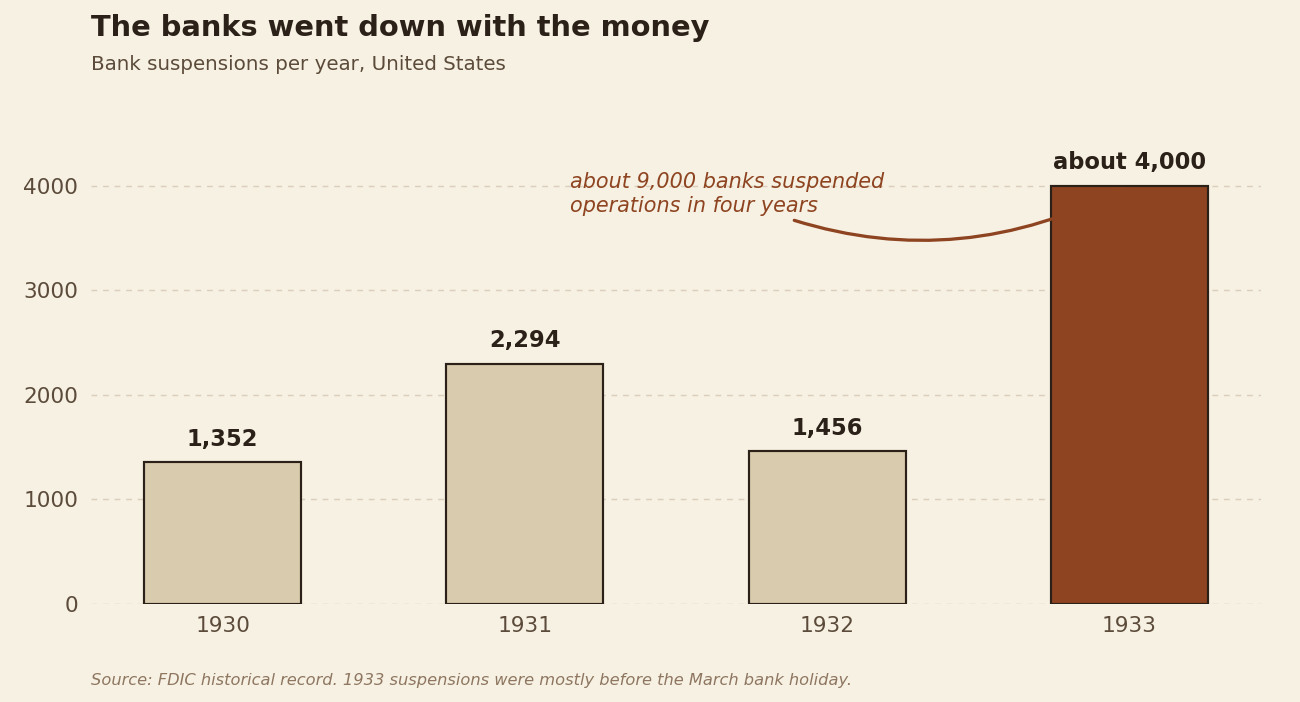
In the fall of 1930, a chain of banks in the South collapsed, and runs spread. Then, on December 11, 1930, the Bank of United States closed in New York. It was a private bank despite the official-sounding name, and it was the largest bank failure in American history to that day, with more than 400,000 depositors. Across the country, people did the arithmetic: if that bank could fail, theirs could too. They lined up to take their money home, and a bank that has lent its deposits out cannot hand them all back at once. Runs killed good banks and bad banks alike.
While the banks were failing, Washington added two more errors. In June 1930, President Hoover signed the Smoot-Hawley tariff, raising duties on imports over the petition of more than a thousand economists who begged him not to. Other countries retaliated. World trade shrank by about two thirds in the years that followed, and the contraction went global.
Then gold delivered the worst blow. In September 1931, Britain gave up and left the gold standard. Investors immediately wondered whether the dollar was next, and gold began flowing out of the United States. The rules of the gold standard said the Fed had to defend the dollar, so the Fed raised interest rates, lifting its discount rate from 1.5% to 3.5% in a few weeks, in the middle of a collapsing economy, to keep the gold. It kept the gold. It also tightened money at the exact moment the country was suffocating for lack of it.
The result was deflation, and deflation is the cruelest force in this entire series. Prices fell by about a quarter between 1929 and 1933. When prices fall, every debt grows heavier in real terms, because the debt stays fixed while the income to pay it shrinks. A farmer who owed $1,000 owed the same $1,000 with wheat at half the price. So debtors sold what they had to raise cash, which pushed prices down further, which made the next debt heavier. Economists call it debt deflation. It needs nobody to make a new mistake. It runs on its own.
By the bottom, roughly 9,000 banks had shut their doors, about a third of the country's banks. Real output had fallen by about 30%. Unemployment reached one worker in four. The Dow, which had already crashed in 1929, kept falling through all of it and finally closed at 41.22 on July 8, 1932, down 89% from the peak.
The end came only when the system broke completely. In March 1933, with banks failing by the thousand, President Roosevelt declared a national bank holiday and closed every bank in the country. Congress then did the two things that had been needed all along: it created federal deposit insurance, so a depositor never again had to run, and the United States left the gold standard, freeing money to expand. The panic stopped. The pattern held everywhere: countries that left gold earlier recovered earlier. The chains were the problem, and once the chains came off, the recovery could start.
1929 broke the market. The gold standard, the bank runs, and the men who refused to fight them broke the economy.
The number that mattered
Ask anyone for the number of 1929 and they will give you 89%, the Dow's fall from peak to bottom. It is a terrible number. It is not the number that mattered.
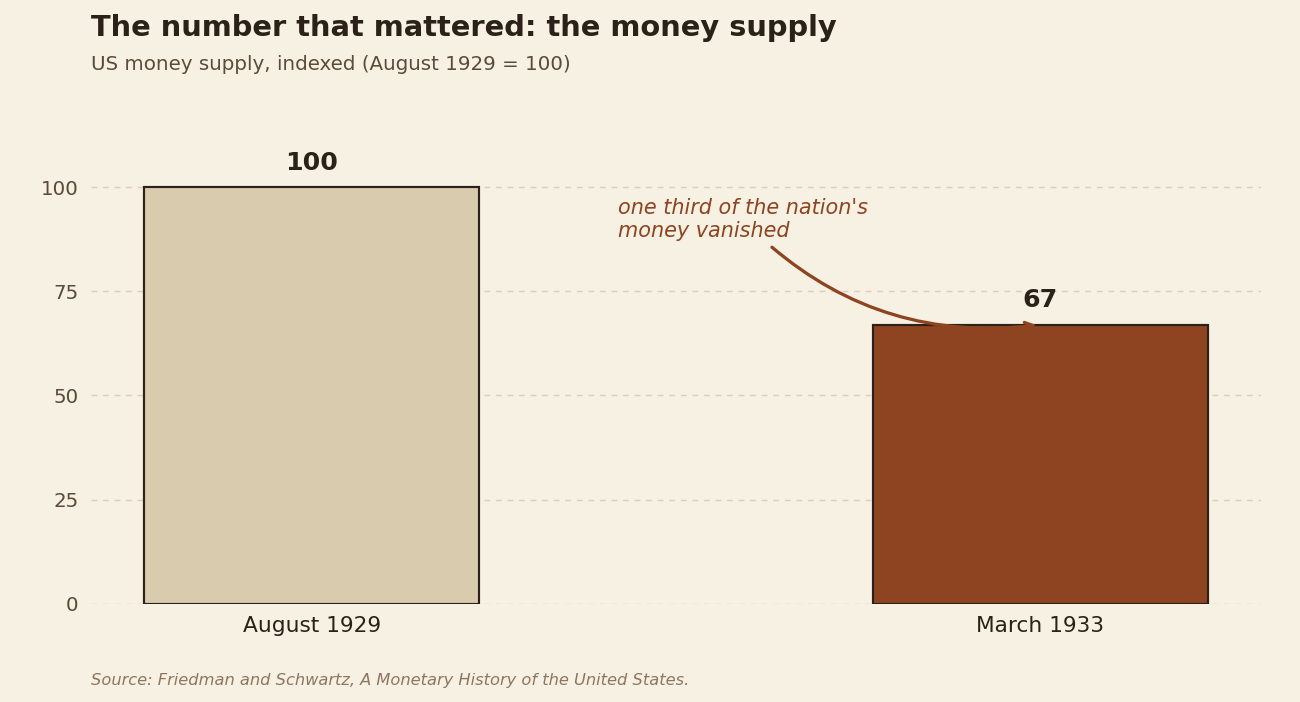
The number that mattered is one third. That is how much of America's money supply vanished between 1929 and 1933. Not lost in the market: vanished. When a bank failed, its deposits died with it. When frightened people pulled cash out and kept it at home, that money stopped circulating. Milton Friedman and Anna Schwartz went back over the records and showed, in the most influential economic history ever written about this period, that the Fed had watched the nation's money shrink by about a third and had not replaced it. A country cannot run on two thirds of its money. Prices, wages, and output had to fall by something like the same proportion, and they did.
In 2002, seventy years later, a future Fed chairman named Ben Bernanke stood up at Friedman's 90th birthday and said it out loud, on behalf of the Federal Reserve: we did it, and we won't do it again. In 2008 and again in 2020, facing collapses that could have rhymed with 1929, the Fed did the opposite of 1930: it lent freely, bought assets by the trillion, and replaced the vanishing money before the deflation could start. That is the 1929 lesson, installed. The reason those crises were severe recessions instead of depressions is that the men running the central bank had studied this one.
Crashes are common. Depressions are a policy choice.
The man who learned it in person
One investor lived all of this at full force and came out the other side with the philosophy this letter keeps quoting. Benjamin Graham ran a fund through the boom, and he was good: he beat the market on the way up. But he went into the crash carrying borrowed money against part of the portfolio, convinced his stocks were worth more than their prices. Prices did not care. From 1929 to 1932 his fund lost about 70% of its value. He kept his investors, refused fees until the losses were earned back, and made them whole by 1935.
What he did with the scar tissue is why we still read him. Teaching at Columbia through the collapse, he and David Dodd wrote Security Analysis, published in 1934, the founding text of value investing. Its core rule came straight out of his own near-destruction: never depend on the market being right, and never buy without a margin of safety, a gap between the price you pay and the value you can defend, wide enough to survive being wrong. Years later, in The Intelligent Investor, he gave the idea its famous form: in the short run the market is a voting machine, in the long run it is a weighing machine. Graham did not learn that in a classroom. He learned it watching the votes nearly bury him, and waiting for the weighing to save him.
The lesson that still applies
Strip the period clothing off 1929 and the machinery is familiar. A true story about the future, bought with borrowed money, in structures that layered leverage on leverage, while the referees decided their job was to punish the speculation rather than to protect the system. The asset was radio stocks and investment trusts. It has since been houses, and it will be something else next time.
The durable lesson is not that bubbles pop. Everyone knows bubbles pop. The lesson is that what happens after the pop is a choice. In 1930 the authorities chose liquidation, gold, and balanced budgets, and got a depression. In 1987, 2000, 2008, and 2020 the authorities chose liquidity, guarantees, and speed, and got recessions, some of them brutal, none of them 1933. When the next crisis comes, and it will, the question that decides your outcome is not how it starts. It is whether the people in charge have read this chapter.
Next in the series: 1982, when the debt crisis came for a whole continent, and Brazil lived the worst version of it.
Subscribe to The Weekend Spread for the next piece in the series.
Numbers in this piece
Crashes are common. Depressions are a policy choice.
The question that decides your outcome is not how a crisis starts. It is whether the people in charge have read this chapter.